
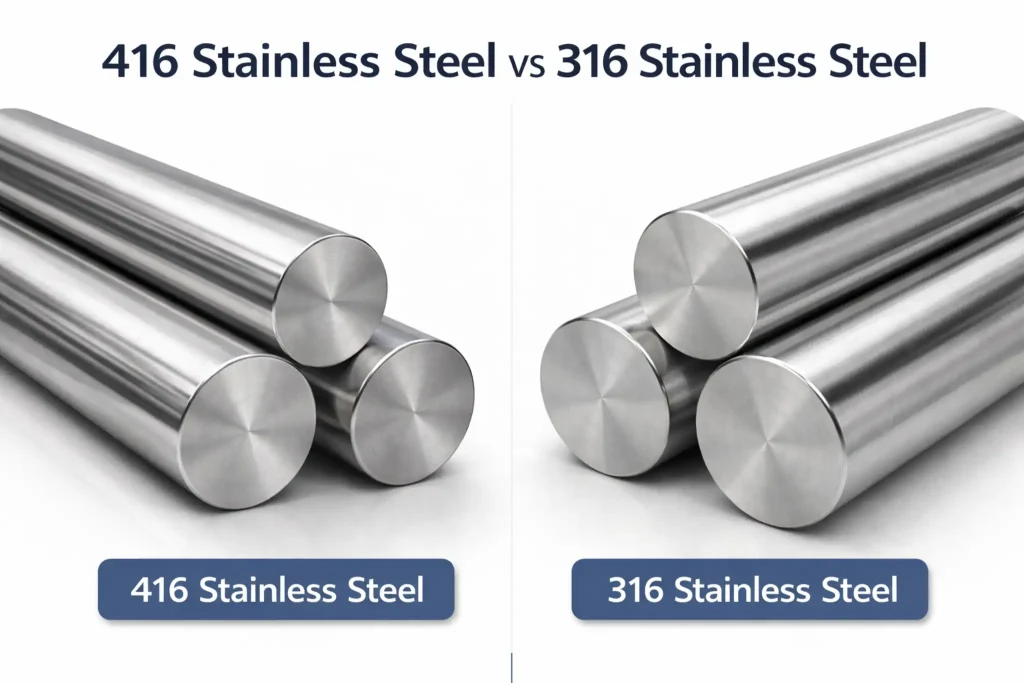

316 and 416 are both common stainless steel grades and are often compared in industrial manufacturing and machining applications. Although both belong to the stainless steel family, they differ in alloy composition, microstructure, and practical manufacturing behavior, which leads to clear differences in the types of parts and service conditions they are suited for.
In real-world projects, 316 and 416 are commonly used for shafts, valve components, fasteners, and other industrial parts that require good surface quality, dimensional stability, or environmental resistance. This article explains 316 and 416 stainless steel from the perspectives of material definition, key differences, advantages and disadvantages, typical applications, and selection considerations, helping you better understand the practical boundaries of these two materials.
What Is 316 Stainless Steel?
316 stainless steel is a common austenitic stainless steel grade that is often used in industrial applications where environmental stability is important. Its main alloying elements include chromium, nickel, and molybdenum, and the addition of molybdenum helps improve its suitability for wet, chloride-containing, and certain chemically exposed environments.
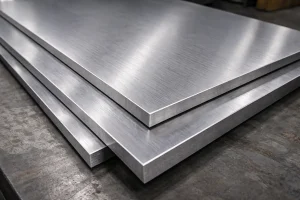
In practical applications, 316 is commonly used for chemical equipment, marine components, food processing equipment, laboratory parts, and other industrial components that require cleanliness and corrosion resistance. In addition to its strong environmental adaptability, 316 usually offers good weldability and formability, which makes it a common choice for projects that involve welding, bending, or later-stage assembly.
What Is 416 Stainless Steel?
416 stainless steel is a common martensitic stainless steel grade that is often used in industrial applications where machining efficiency and mechanical performance are important. Its composition is primarily based on chromium and also includes a controlled amount of sulfur, a feature that helps improve cutting performance during machining.
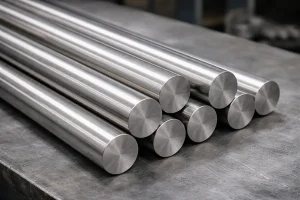
In practical manufacturing, 416 is commonly used for shafts, valve components, pump parts, fasteners, and other mechanical parts that require efficient turning, drilling, tapping, or automatic lathe operations. In addition to its good machinability, 416 can also be heat treated to achieve higher hardness and strength, which makes it suitable for parts that require a certain level of wear resistance or load-bearing capacity.
Key Differences Between 316 and 416 Stainless Steel
Although both 316 and 416 belong to the stainless steel family, they do not serve the same priorities in manufacturing and end use. In practical engineering, what matters most is not every material detail, but the key differences that affect machining, part performance, and service conditions.
Resistência à corrosão
316 is more commonly used in wet, chloride-containing, salt spray, or certain chemically exposed environments. Its material characteristics generally allow for better long-term surface stability, which is why it is often used in chemical equipment, marine hardware, food processing systems, and sanitary-related components.
416 is also a stainless steel, but it is more commonly seen in industrial applications with relatively mild service conditions. Under general conditions, it can meet standard performance needs; however, when parts are exposed to salt, moisture, or corrosive media over a long period, its suitability usually needs to be evaluated more carefully. For applications involving more demanding environments, 316 is often more likely to be considered.
Maquinabilidade
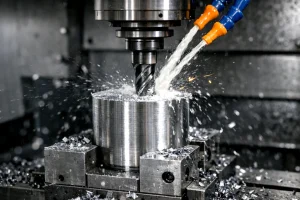
In cutting operations, 416 is generally more suitable for high-efficiency manufacturing. It is often used in turning, drilling, tapping, and automatic lathe operations, especially for high-volume machined parts. For projects that require stable production rhythm and efficient machining output, 416 often offers a clearer manufacturing advantage.
316, by contrast, is more prone to work hardening during machining. As a result, it usually requires more stable tooling conditions, cutting parameters, and process control. This does not mean that 316 cannot be machined, but it generally demands a more controlled machining process.
Heat Treatment and Hardness
416 has more distinct characteristics in terms of heat treatment and hardness. As a martensitic stainless steel, it can be heat treated to increase hardness and strength, which makes it suitable for mechanical parts that require wear resistance, load-bearing capacity, or higher surface hardness.
316 is not typically defined by heat-treatment strengthening. Its value lies more in environmental stability and overall fabrication adaptability. For this reason, 416 is often more visible in projects that require higher hardness or heat-treated mechanical performance, while 316 is more commonly used in applications that emphasize long-term stability.
Weldability and Magnetism
316 generally offers better weldability and forming adaptability, which makes it more suitable for parts that require welding, bending, or later-stage assembly. For projects involving more complex manufacturing routes, this can be an important advantage.
416 is usually less suitable for welded applications, so it is more often used in parts that are primarily shaped through machining rather than extensive welded fabrication.
In terms of magnetic behavior, 316 is usually non-magnetic or only slightly magnetic, while 416 is magnetic. For general mechanical parts, this may not always be a decisive factor, but in certain equipment, instruments, or magnetically sensitive applications, it can influence material selection.
Comparison Table: 316 vs 416 Stainless Steel
| Comparison Item | Aço inoxidável 316 | 416 Stainless Steel |
|---|---|---|
| Tipo de material | Austenitic stainless steel | Martensitic stainless steel |
| Main Alloy Characteristics | Contains chromium, nickel, and molybdenum | Contains chromium with a controlled sulfur addition |
| Material Positioning | More focused on environmental stability and overall fabrication adaptability | More focused on machining efficiency and mechanical use |
| Corrosion Behavior | Better suited to wet, chloride-containing, and certain chemical environments | Better suited to relatively mild service conditions |
| Maquinabilidade | Moderate, with a greater tendency toward work hardening | Better, suitable for high-efficiency cutting operations |
| Heat-Treating Capability | Not typically selected for heat-treatment strengthening | Can be heat treated to increase hardness and strength |
| Soldabilidade | Generally better | Generally weaker |
| Magnetism | Usually non-magnetic or slightly magnetic | Clearly magnetic |
| Typical Part Types | Chemical equipment parts, marine hardware, food equipment, laboratory parts | Shafts, valve components, pump parts, fasteners, precision machined parts |
Advantages and Limitations of 316 and 416 Stainless Steel
After understanding the main differences between the two grades, it becomes easier to evaluate their strengths and limitations in practical use. In general, 316 is more often associated with environmental stability and fabrication adaptability, while 416 is more often associated with machining efficiency and mechanical-use parts. In real projects, these advantages and limitations should be considered together rather than in isolation.
Main Advantages of 316 Stainless Steel
316 is often selected for applications that require stable performance in more demanding service conditions. Its main advantages include:
- Good performance in wet, chloride-containing, and certain chemically exposed environments
- Good weldability and formability for fabricated parts
- Suitable for industrial applications that require cleanliness, durability, and stable surface performance
Main Limitations of 316 Stainless Steel
Although 316 offers a balanced overall profile, it is not the most efficient option in every manufacturing situation. Its main limitations include:
- Lower machining efficiency in heavily machined parts
- Greater tendency toward work hardening during cutting
- Not typically selected when heat-treated hardness is a key requirement
Main Advantages of 416 Stainless Steel
416 is more often used in projects where machining efficiency and mechanical performance are important. Its main advantages include:
- Good machinability in turning, drilling, tapping, and automatic lathe operations
- Heat-treatable for higher hardness and strength
- Well suited to batch production of precision machined mechanical parts
Main Limitations of 416 Stainless Steel
416 also has clear application boundaries that need to be considered during material selection. Its main limitations include:
- Less suitable for prolonged exposure to salt, moisture, or corrosive media
- Generally weaker weldability for fabrication-heavy projects
- More appropriate for mechanical-use parts than for complex service environments
Typical Applications of 316 and 416 Stainless Steel
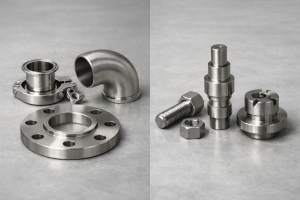
In addition to their material properties, these two grades also tend to appear in different types of industrial parts. 316 is more commonly used in components that require environmental stability and long-term surface reliability, while 416 is more commonly used in parts where machining efficiency and mechanical performance are more important.
Typical Applications of 316 Stainless Steel
316 is commonly used in parts that must maintain stable performance in more demanding environments. Typical applications include:
- Chemical equipment and corrosion-resistant piping components
- Marine hardware, fittings, and exposed structural parts
- Food processing, laboratory, and sanitary-related components
Typical Applications of 416 Stainless Steel
416 is more commonly used in parts where machining efficiency and mechanical performance take priority. Typical applications include:
- Precision machined parts produced through efficient cutting operations
- Shafts, valve components, and pump parts
- Fasteners, threaded parts, and certain drive-related components
How to Choose Between 316 and 416 Stainless Steel
When choosing between 316 and 416, the most important question is not which material sounds better, but what the part actually needs.
If corrosion resistance is the main concern, especially in wet, salt spray, marine, cleaning-fluid, or chemical environments, 316 is usually the better choice. Its advantage lies in environmental stability and long-term durability rather than machining speed.
If machinability is the main concern and the part requires extensive cutting while corrosion risk is relatively low, 416 often provides better manufacturing value. It is better suited for efficient machining and heat-treatable mechanical parts.
If the part will require welding, bending, or more complex forming, 316 is usually safer than 416. On the other hand, if the part is more like a shaft, valve stem, mechanical connector, or another precision turned component, 416 is often more appropriate.
From a practical engineering perspective, 316 is generally better for environment-first applications, while 416 is better for manufacturing-first applications. Effective material selection should always consider service conditions, manufacturing route, performance requirements, and overall cost together.
FAQ
Is 416 better than 316
It is not accurate to say that 416 is simply better than 316. If corrosion resistance is the priority, 316 is usually better. If machinability and heat-treating capability are more important, 416 often has the advantage. The right choice depends on whether the part values environmental resistance or manufacturing efficiency more.
Will 416 stainless steel rust
Yes. Although 416 is a stainless steel, it is not immune to rust in all environments. In wet, salty, chloride-rich, or chemical conditions, 416 usually has a higher corrosion risk than 316. It is therefore better suited to milder service environments.
Will a magnet stick to 416 stainless steel
Usually yes. 416 is a martensitic stainless steel and is generally magnetic, so a magnet will usually stick to its surface.
Which steel will never rust
Strictly speaking, no steel will remain rust-free in every environment forever. Stainless steel is more corrosion resistant than ordinary steel, but that does not mean it is completely immune to corrosion. Material selection should still be based on environment, media exposure, and maintenance conditions.
How Can You Tell the Difference Between 316 and 416 Stainless Steel?
In practical shop-floor situations, magnetism is often used as a quick initial check. 416 stainless steel is generally magnetic because it belongs to the martensitic stainless steel family, while 316 stainless steel is usually non-magnetic or only slightly magnetic in the annealed condition. However, magnet testing alone should not be treated as a final identification method.
For formal verification, the more reliable approach is to review the material certificate, mill test report, or traceable material marking. In situations where material mix-up would create performance or compliance risks, additional identification methods such as PMI testing may also be used.
Conclusão
316 and 416 are both common stainless steel grades, but they represent two different material selection strategies. 316 is more suitable for corrosion-resistant applications, welded components, and parts used in demanding environments. 416 is more suitable for efficient machining, heat-treatable strengthening, and mechanical parts.
If your project prioritizes long-term corrosion resistance and environmental stability, 316 is usually the safer choice. If your project values machining efficiency, hardness potential, and manufacturing economy more, 416 often has the advantage. Effective material selection is not just about comparing grade numbers, but about evaluating service environment, process route, and part function together.