
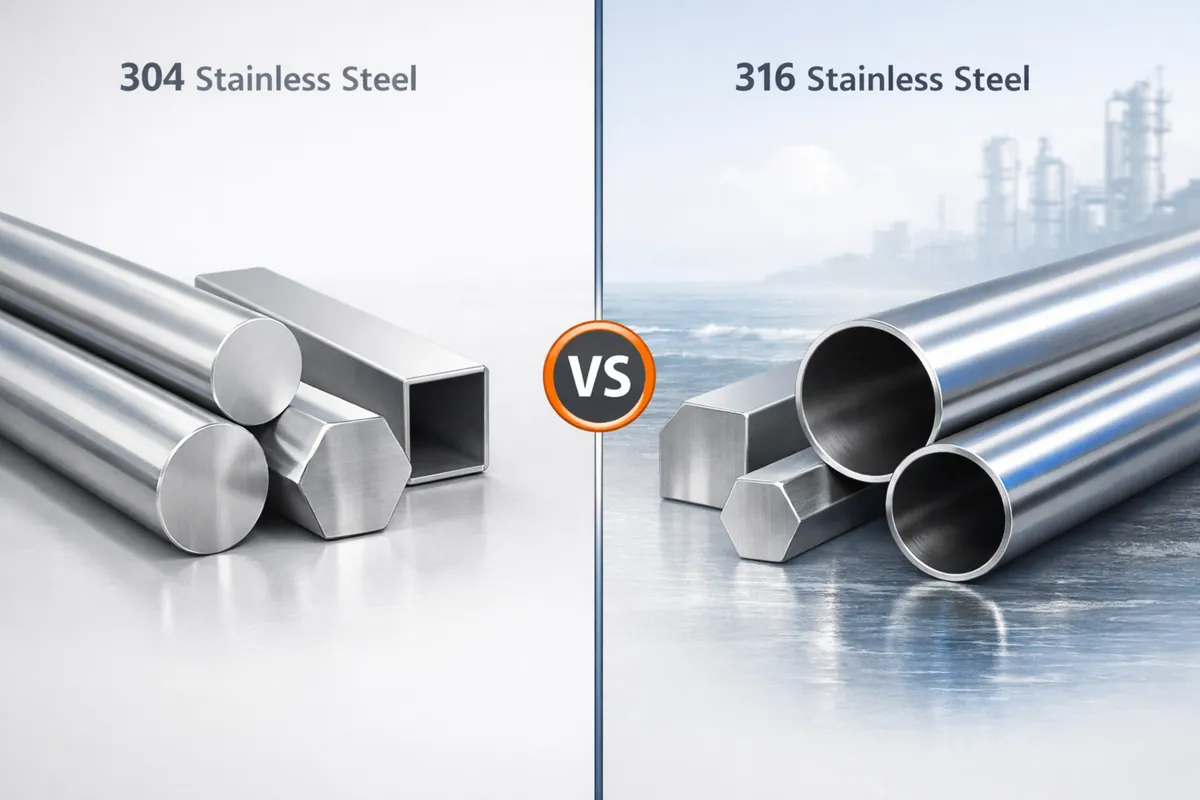

In the world of engineering and manufacturing, Grade 304 and Grade 316 are the two most frequently specified austenitic stainless steels. While they appear virtually identical to the naked eye, they possess significant differences in corrosion resistance, service life, and procurement cost.
This guide focuses on clarifying the key differences between these two alloys to help you select the right grade for your specific application.
304 vs. 316 Stainless Steel: Quick Answer
If you need to make a fast decision, the table below summarizes the core logic:
| Feature | 304 Stainless Steel | 316 Stainless Steel |
| Core Composition | 18% Cr + 8% Ni | 16% Cr + 10% Ni + 2-3% Mo |
| Corrosion Resistance | Good | Excellent (Resists Pitting/Salt) |
| Typical Environment | Indoor, General Atmosphere | Coastal, Chemical, Medical |
| Cost Level | Economic (Baseline 1.0) | Premium (Approx. 1.3 – 1.5) |
What is 304 Stainless Steel?
AISI 304 is the most widely used stainless steel grade globally. Part of the austenitic family, it is renowned for its versatility. To improve corrosion resistance after welding, a low-carbon version, 304L, is often used. As an “18/8” stainless steel, it remains extremely stable in most non-corrosive media and offers exceptional formability.
The primary advantages of this material are its high cost-effectiveness and excellent deep-drawing properties, allowing it to be easily processed into complex shapes. For freshwater, general atmospheric conditions, and most consumer goods, 304 is the preferred choice for balancing strength and cost.
What is 316 Stainless Steel?
AISI 316 is commonly referred to as “Marine Grade” stainless steel. The most significant difference from 304 is the addition of 2% to 3% Molybdenum (Mo). This chemical adjustment is the core of its performance leap; molybdenum significantly enhances the material’s resistance to pitting and crevice corrosion, particularly in high-temperature or chloride-rich environments.
The typical advantage of 316 is its longevity in harsh environments. It not only resists seawater corrosion but also remains stable in many chemical acidic media. While it carries a higher price tag, 316 is an indispensable professional choice in fields where safety and durability are paramount.
304 vs. 316: Key Differences
Chemical Composition
304 contains approximately 18% chromium and 8% nickel, with no molybdenum. In contrast, 316 has a slightly lower chromium content but a higher nickel percentage (about 10%+) and includes 2-3% molybdenum. Molybdenum strengthens the passive film at a microscopic level and is the defining characteristic of Grade 316.
Corrosion Resistance
In chloride-rich environments (such as seawater, salt spray, de-icing salts, and strong cleaning agents), 304 is highly susceptible to “pitting”—small black spots on the surface that rapidly penetrate inward. 316, protected by molybdenum, significantly resists this localized electrochemical attack, providing much higher durability in saline or chemically corrosive environments.
Mechanical Properties and Durability
While their room-temperature tensile strengths are very similar, 316 offers slightly better fatigue resistance over long-term service. In chemical piping systems involving high-frequency vibration or severe mechanical stress, 316 typically provides higher structural reliability than 304.
Temperature Resistance
Due to the presence of molybdenum, 316 maintains its mechanical strength more effectively at high temperatures. In environments exceeding 400°C, 316 demonstrates superior creep resistance (resistance to deformation under heat), making it better suited for high-temperature exhaust systems or heat exchangers.
Formability and Welding
304 has better ductility, making it more “user-friendly” for parts requiring deep drawing or complex bending. While both grades offer excellent weldability, the welds of 316 generally exhibit better corrosion stability in certain acidic media compared to 304 welds.
Magnetism and Appearance
Both grades are typically non-magnetic in the annealed state, though they may show slight magnetism after cold working. Visually, 304 and 316 are nearly identical and cannot be distinguished by the naked eye. Engineers usually rely on chemical drop tests or X-ray fluorescence (PMI) analyzers to verify the grade.
Cost and Availability
304 is the market standard, widely available with massive inventory and an economical price point. 316 is influenced by the fluctuating prices of molybdenum and nickel, typically costing 30% to 50% more than 304. Certain specialized specifications for 316 may also have longer lead times.
Common Application Scenarios
Selecting the right grade depends heavily on the specific industry and environmental stressors the material will face. While 304 dominates consumer goods, 316 is the standard for high-salinity or acidic conditions.
Common Applications for 304 Stainless Steel
- Kitchen Equipment: Dishwashers, household water pipes, stainless steel sinks, cookware, and cutlery.
- Appliances: Refrigerator linings, microwave interiors, and electric water heater casings.
- Architectural Decor: Indoor handrails, elevator cabins, indoor ceiling panels, and interior cladding.
- General Industry: Heat exchangers, standard pressure vessels, food processing lines, and light industrial machinery.
Common Applications for 316 Stainless Steel
- Marine Engineering: Ship deck fittings, yacht hardware, offshore platform components, and subsea piping.
- Chemical Processing: Reaction vessels, piping for strong acids, and corrosive chemical storage tanks.
- Pharmaceutical & Medical: Surgical implants, orthopedic joints, precision medical instruments, and cleanroom equipment.
- Outdoor Facilities: Coastal building facades, lamp posts in salt-spray environments, and bridge railings.
Which Should You Use: 304 or 316?
General Atmosphere / Indoor / Light Industrial
If your equipment is located inland and does not involve aggressive chemical cleaning, 304 is the most cost-effective solution. It provides sufficient lifespan while significantly saving on procurement budgets.
Coastal, Salt Spray, or Chloride Chemical Environments
If the project is located within 5km of the coastline, or involves swimming pools, chloride bleaches, or plants handling strong acids, you must use 316. Using 304 in these conditions will lead to surface rusting or even perforation failure within a short period.
Is 304 or 316 Better for Food?
- Household Use: 304 is perfectly adequate. Most high-quality cookware is marked 304, which resists water and common food acids.
- Commercial/Extreme Conditions: For commercial kitchens handling high-salt cured foods or those requiring frequent sanitization with strong disinfectants, 316 provides longer-lasting surface brightness.
Common Questions (FAQ)
Which is better: 304 or 316 stainless steel?
There is no absolute “better,” only “more suitable.” For indoor railings, 304 is better. For a boat propeller, 316 is better.
What are the disadvantages of 304 stainless steel?
The primary disadvantage is its poor resistance to chloride corrosion. In saline environments (like the coast), it will pit and rust rapidly.
Is 304 or 316 stainless steel better for food?
304 is considered the standard food-grade stainless steel for most processing. However, 316 is the superior choice for high-salt foods or applications involving high-concentration acidic cleaners.
What are the disadvantages of 316 stainless steel?
The main drawbacks are the higher cost (30%+ premium) and increased difficulty in machining. Using it in a dry, non-chloride environment is a waste of resources.
Conclusion
When making your final material selection, remember: 304 stands for versatility and economy, while 316 stands for high reliability in corrosive environments.
The simplest selection logic is to first check the chloride concentration of the environment. If the environment is harsh, choose 316 to avoid expensive downtime and repairs in the future. If the environment is mild, choose 304 for maximum value.
If you have specific casting or machining needs and are unsure which grade fits your design, contact our technical experts for a tailored quote and material consultation.