

Aluminum alloys offer good corrosion resistance, but this does not mean corrosion can be ignored under all service conditions. For CNC-machined structural components, corrosion is rarely a uniform, material-wide issue. Instead, it is usually localized, driven by the combined effects of the operating environment, part geometry, and connection methods.
This article outlines the corrosion risks aluminum parts may encounter in practical applications and explains how these risks can be managed through appropriate engineering decisions.
Aluminum Rust and Aluminum Corrosion
In materials science terms, aluminum does not produce “red rust” (iron oxide) like carbon steel, but it does undergo oxidation and corrosion.
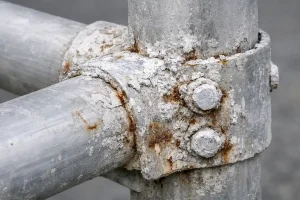
The term “rust” specifically refers to the iron oxide formed on iron and steel. Since aluminum alloys contain no iron, they never develop reddish-brown rust.
The Natural Protective Film
Upon contact with air, aluminum rapidly forms a dense aluminum oxide layer . To the naked eye, this appears as a slight dulling or graying of the surface. For most indoor applications, this layer acts as a natural shield; while it reduces surface luster, the internal metal and load-bearing capacity remain largely unaffected.
Structural Integrity Concerns
In normal industrial environments, aluminum rarely experiences the massive scaling, flaking, or “rusting through” typical of carbon steel. The real concerns are localized severe corrosion caused by salt-rich environments, stagnant water in crevices, or contact with dissimilar metals, which are the primary factors affecting structural integrity.
Types of Aluminum Corrosion
Understanding common corrosion types is the foundation for an effective protection plan. While aluminum doesn’t “rust,” it corrodes due to environmental factors, typically producing white or grayish-white powder and oxide films.
Uniform Oxidation
This is the most common surface change in normal atmospheric conditions. It is essentially the thickening of the natural oxide film and usually only affects aesthetics with minimal impact on structural strength.
- Appearance: Surface changes from bright silver to dull gray or matte (cloudy).
- Primary Cause: Long-term exposure to standard atmospheric conditions.
- Recommendation: Primarily an aesthetic issue. Use Anodizing, Polishing, or Brushing for a more stable and attractive finish.
Pitting Corrosion
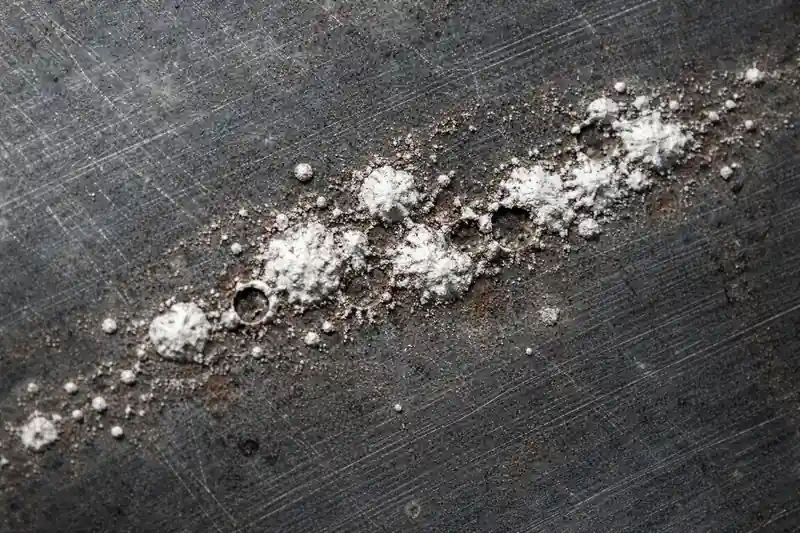
Pitting is a localized corrosion and the most common failure mode for aluminum in chloride-rich environments. Once it starts, it forms tiny but deep cavities , threatening fatigue life and sealing performance.
- Appearance: Localized white powder; once wiped away, small pits are visible.
- Primary Cause: High concentrations of chloride ions (e.g., coastal salt spray, de-icing salts, chlorinated cleaners).
- Recommendation: Use 5xxx series alloys for better resistance; apply high-thickness Anodizing or Powder Coating/Painting to create a complete barrier.
Galvanic Corrosion
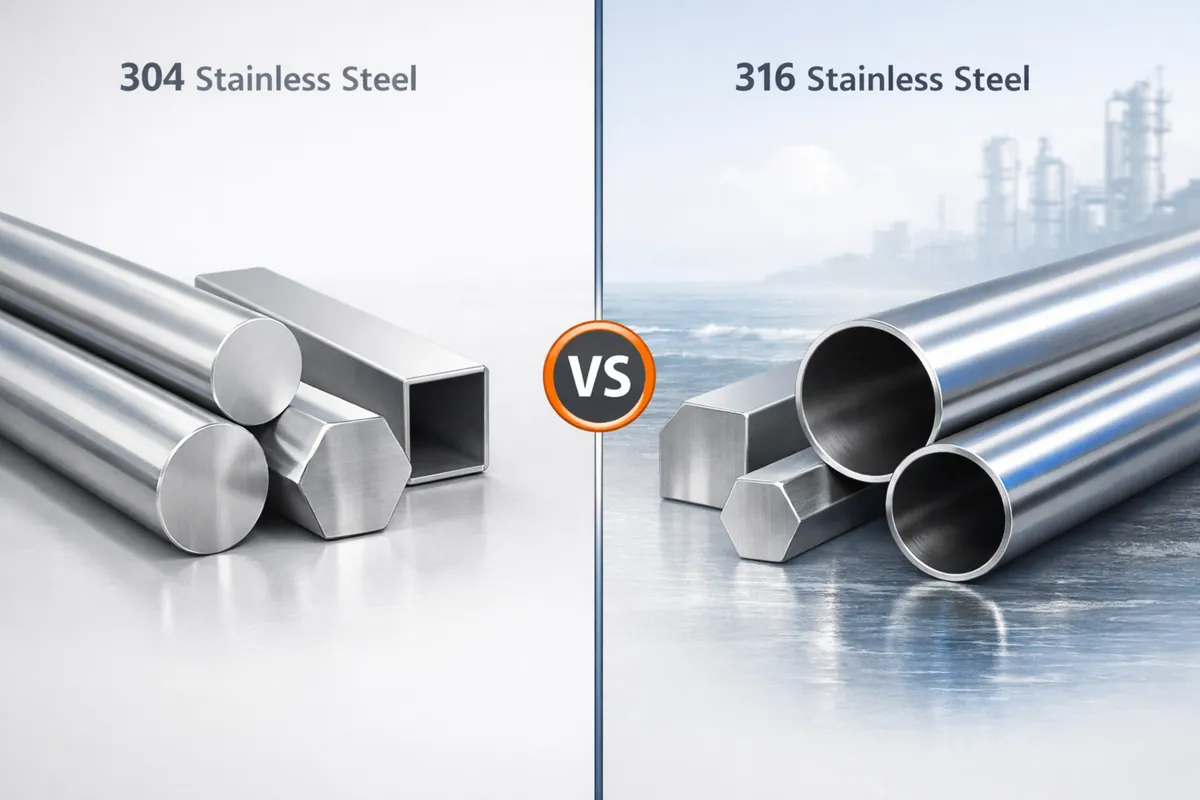
When aluminum contacts a more noble metal (like stainless steel or copper) in a moist environment, the aluminum acts as an anode and dissolves preferentially . This corrosion is highly destructive and concentrated around connection points.
- Appearance: Intense corrosion concentrated at the contact point with dissimilar metals.
- Primary Cause: Connections between aluminum and stainless steel/carbon steel in moist or electrolytic environments.
- Recommendation: Use insulating washers, bushings, or anti-corrosion sealants to isolate the metals; avoid exposing metal contact surfaces in high salt-spray areas.
Intergranular Corrosion
This occurs at the grain boundaries of the alloy. The surface may show little change, but the internal structure loses strength—similar to “rotting wood.” This is a major safety hazard for high-strength parts.
- Appearance: Surface looks intact, but sudden brittle failure occurs under load, or fine network cracks appear.
- Primary Cause: Improper heat treatment, leading to uneven chemical composition at grain boundaries (common in 2xxx and 7xxx series).
- Recommendation: Strictly control heat treatment processes (e.g., T6 state) and choose suppliers with rigorous material quality control.
Stress Corrosion Cracking (SCC)
This is the result of the combined action of tensile stress and a corrosive environment. It is the most dangerous failure mode for structural parts because it often leads to sudden cracking without warning.
- Appearance: Parts fracture suddenly at loads far below their yield strength.
- Primary Cause: Large residual processing stresses (due to aggressive CNC roughing or clamping deformation) combined with moisture.
- Recommendation: Perform stress-relief annealing after machining high-strength aluminum; reduce stress concentration points in the design (e.g., increase R-fillets).
Crevice Corrosion and Under-film Corrosion
This occurs when water and corrosive media are trapped in stagnant areas (like lap joints or gasket edges), causing the local pH to deteriorate sharply.
- Appearance: Accumulation of white corrosion products inside crevices; coating blistering or peeling.
- Primary Cause: Stagnant water in design dead zones.
- Recommendation: Avoid stagnant designs; add drainage grooves or holes; use proper chamfering to ensure uniform coating coverage.
How to Prevent Aluminum Corrosion?
Anti-corrosion strategies must be integrated from the initial design phase through the final machining stages.
Material Selection Strategy
Alloy composition has a direct impact on how aluminum performs in corrosive environments. For CNC-machined structural parts, material selection should be based on both mechanical requirements and long-term exposure conditions.
In practical machining applications, corrosion performance can be broadly understood as follows:
- 5xxx Series (Al–Mg Alloys)
Alloys such as 5052 and 5083 offer excellent resistance to salt spray and humid environments. They are commonly selected for marine, outdoor, and chemical-related applications where corrosion resistance is a priority. - 6xxx Series (Al–Mg–Si Alloys)
6061 and 6082 provide a balanced combination of strength, corrosion resistance, and machinability. This makes them the most widely used aluminum alloys for CNC-machined structural components. - 7xxx Series (Al–Zn–Mg–Cu Alloys)
High-strength alloys like 7075 are more sensitive to environmental corrosion and stress corrosion cracking. When used in structural parts, they require strict stress control and robust surface protection.
Selecting an alloy that matches the service environment reduces reliance on aggressive surface treatments and improves long-term reliability.
2. Structural Design Strategy
The core objective is to eliminate areas where corrosive media can collect and to prevent electrochemical reaction points.
- Drainage Design: Avoid stagnant dead zones; include drainage holes to prevent crevice corrosion.
- Profile Optimization: Use chamfers or radii to ensure surface treatments (like paint) cover all edges uniformly.
- Dissimilar Metal Isolation: Use insulating gaskets or sealants to completely eliminate galvanic corrosion.
3. Common Surface Treatment Methods
Once the material and design are finalized, surface treatment is the final step to provide an extra barrier against the environment.
| Method | Purpose & Features | Best For |
| Anodizing | Thickens oxide layer; improves resistance and wear; available in colors. | Most indoor & light outdoor parts |
| Hard Anodizing | Much thicker layer; extremely high wear resistance. | Parts in abrasive & harsh environments |
| Powder / Paint | Creates an organic barrier coating. | Large housings, outdoor structures |
| Chemical Film | Often used as a pre-treatment; provides some conductivity. | Electronics & parts requiring grounding |
Conclusion
Aluminum corrosion is essentially a localized failure occurring under specific environmental and design conditions, rather than a simple matter of “will it rust.”
As long as material selection, drainage design, dissimilar metal isolation, and surface treatments are planned together in the early stages, aluminum alloys can operate stably for the long term, even in harsh conditions.
👉 Feel free to send us your drawings and environmental requirements. Our engineering team can provide a complete machining and anti-corrosion proposal for your aluminum parts.
FAQ
1. Will aluminum rust if it gets wet?
Answer: Aluminum will not produce red rust. It rapidly reacts with water and oxygen to form a dense protective aluminum oxide film. In daily freshwater environments, this film effectively protects the internal metal.
2. Does aluminum corrode outdoors?
Answer: It will oxidize and dull. In high salt-spray areas (like the coast) or areas with stagnant water, pitting may occur, which can affect aesthetics and structural strength.
3. How long does it take for aluminum to corrode?
Answer: Aluminum forms its natural protective oxide layer in seconds. Harmful corrosion (like pitting) depends on the environment: it can last decades indoors, but without protection, it may show visible corrosion in weeks in high-salt environments.
4. Will bare aluminum rust?
Answer: Bare aluminum will oxidize. However, this oxidation is beneficial as it forms the metal’s natural shield. Harmful corrosion only occurs when bare aluminum is exposed to harsh media (like chloride ions or strong alkalis) or contacts dissimilar metals.