

In the modern landscape of precision manufacturing, nickel and nickel alloys (such as Inconel 718, Monel, and Hastelloy) are highly regarded for their outstanding performance under extreme conditions. However, for machining shops, the high strength and toughness of these materials translate into significant machining challenges. This article provides an objective perspective on the machining characteristics of nickel alloys and the strategies for handling them.
What are Nickel Alloys?
From a chemical composition standpoint, nickel alloys are engineering materials based on nickel (Ni) with precise additions of elements like chromium, molybdenum, iron, copper, cobalt, niobium, titanium, and aluminum. The core of their performance lies in their strengthening mechanisms: through solid solution strengthening or precipitation hardening, the material establishes a stable structure at the atomic level. This microstructure gives the material stronger resistance to plastic deformation, ensuring that its internal crystal lattice maintains high stability even under high-temperature working conditions.
Is Nickel Difficult to Machine?
The conclusion is clear: nickel alloys are widely considered “difficult-to-machine materials.” If common carbon steel (such as AISI 1045) is used as a benchmark for machinability, most nickel alloys have an index significantly lower than common industrial metals. This means that within the same production cycle, machining nickel alloys requires more expensive tooling and longer labor hours.
When subjected to cutting forces, the surface of nickel alloys undergoes intense work hardening. If the tool edge is not sharp enough or the depth of cut is too small, subsequent passes will rub against the already hardened “shell,” causing rapid tool failure due to localized heat and stress concentration.
Furthermore, due to the aforementioned thermal conductivity limits, heat is more likely to concentrate near the tool tip. This heat accumulation softens the tool material and exacerbates adhesion issues, making surface defects like tearing or smearing more likely to occur.
Machining Characteristics of Nickel and Nickel Alloys
The machinability of nickel alloys is significantly lower than that of carbon steel or free-machining grades. In production, this often leads to reduced tool life and process instability, requiring a precise balance between metal removal rates and overall tooling costs.
Commercially Pure Nickel (Ni 200, Ni 201)
Pure nickel is characterized by extreme “gumminess” rather than high hardness. It is a soft, ductile material that tends to smear during cutting. The primary challenge is its high adhesiveness, which often leads to severe built-up edge and poor surface finishes. Tools with very sharp cutting edges and high rake angles are necessary to “slice” through the material rather than pushing it.
Nickel-Based Superalloys (Inconel 718, Inconel 625, Waspaloy)
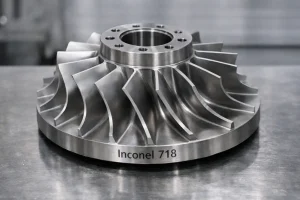
This is the most challenging category. These alloys maintain high shear strength even at elevated temperatures, resulting in massive cutting forces. They are highly prone to severe notch wear, and the presence of hard carbide particles in the alloy leads to intense mechanical abrasion of the cutting tool.
Nickel-Copper Alloys (Monel 400, Monel K500)
These alloys possess extremely high toughness. While not as hard as superalloys, their chips are incredibly tenacious and difficult to break. They are prone to severe Built-Up Edge (BUE), which can tear the workpiece surface, making lubrication management critical.
Nickel-Molybdenum / Chromium-Molybdenum Alloys (Hastelloy C276, Hastelloy C22)
The thermal conductivity of these alloys is among the lowest in the nickel family. Cutting heat remains almost entirely concentrated within a tiny area of the cutting edge, leading to rapid thermal softening of the tool tip. Even minor misjudgments in cutting speed can result in immediate tool failure.
Nickel-Chromium / Nickel-Iron-Chromium Alloys (Incoloy 800, Incoloy 825)
While their machinability is slightly better than the superalloy group, they still exhibit a strong tendency toward work hardening. If the depth of cut fails to penetrate the hardened layer left by the previous pass, the tool will wear prematurely or chip.
Key Material Properties of Nickel Alloys
The ability of nickel alloys to survive harsh conditions stems from unique physical and chemical attributes, which are also the source of machining difficulty:
High-Temperature Mechanical Properties
Nickel alloys retain high tensile and yield strength at elevated temperatures. This means that when high temperatures are generated in the cutting zone, the material does not soften as quickly as carbon steel; the tool tip must withstand massive mechanical loads continuously under heat.
Extremely Low Thermal Conductivity
Nickel alloys have poor thermal conductivity, making it difficult for heat to dissipate through the workpiece or chips. Heat becomes highly concentrated at the interface between the tool and the material, often leading to tool failure due to localized overheating.
Adhesion and Built-up Edge (BUE) Tendency
Nickel is chemically active and tends to weld to the tool material under cutting pressure. This leads to frequent BUE, which not only destroys surface finish but can also pull away microscopic particles of the tool substrate when the BUE breaks off.
Typical Pitfalls in Nickel Alloy Machining
In actual production, without optimizing the process for nickel alloy characteristics, several common issues occur:
- Diverse Tool Failure Modes: Rapid crater wear, notch wear at the depth-of-cut line, and thermal chipping of the coating.
- Unstable Surface Quality: Micro-tearing, smearing, or discoloration (burns) due to overheating.
- Chip Control Difficulties: High-toughness chips are long, stringy, and extremely strong, posing risks of tangling around the tool or workpiece.
- Limited Production Efficiency: To balance tool life, shops often must use lower cutting speeds, resulting in slower overall throughput.
Precautions During Machining
To ensure smooth processing of nickel alloys, establishing a scientific process is vital. Here are several widely verified core principles:
- Monitor Edge Condition: Maintain an absolutely sharp cutting edge. Replace the tool immediately upon observing minor wear to prevent an increase in work-hardening depth.
- Rigidity is Paramount: The rigidity of the setup determines the upper limit of the process. Shorten tool overhang, use high-force collets, and avoid any form of micro-vibration.
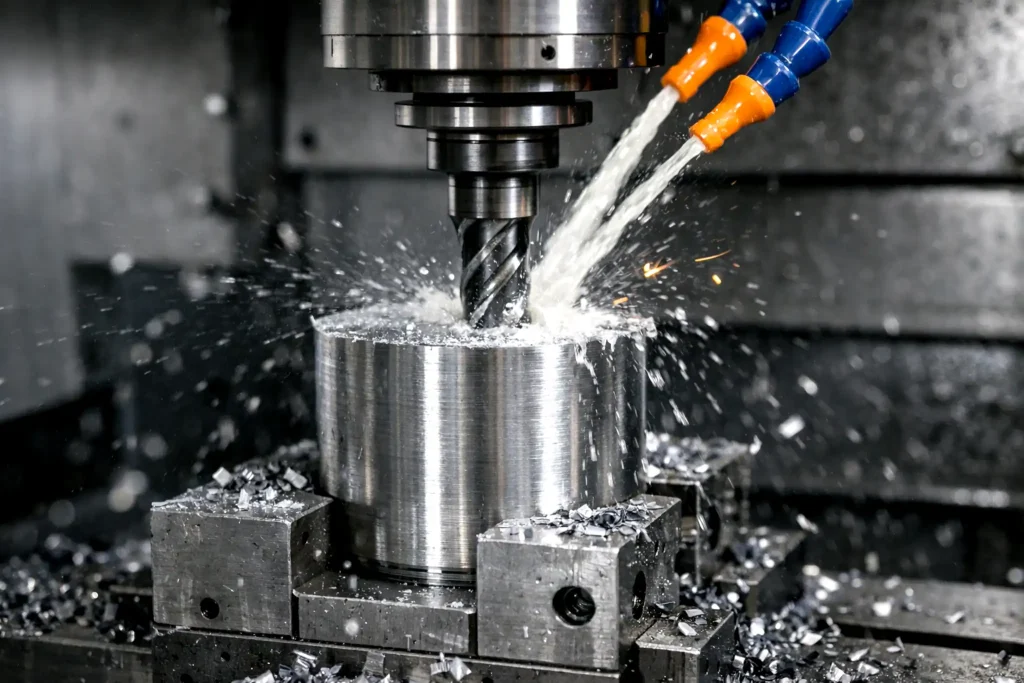
- Lubrication and Cooling Management: Coolant/lubrication should aim for temperature reduction, friction decrease, and chip removal. In some cases, formulas with EP (extreme pressure) additives are used, depending on the grade and machining method.
- Continuous Cutting Strategy: Maintain constant feed movement. Avoid unnecessary pauses during the cut to reduce the formation of localized hardening.
Practical Tips for Success
To improve efficiency, try these advanced practical methods:
- Parameter Optimization: Ensure the depth of cut (DOC) penetrates the work-hardened layer to avoid “rubbing.” Ensure the tool tip is always cutting “fresh,” unhardened metal.
- Path Planning: Prioritize Climb Milling. This allows the chip to go from thick to thin, reducing the instantaneous thermal shock as the tool enters the cut.
- Tool Change Management: Establish a predictive tool change cycle. Do not wait for the tool to fail completely, as an overused tool can ruin the surface quality of an entire batch.
- Drilling Details: Use internal-coolant drills with large flutes and employ frequent peck-drilling strategies to prevent chip clogging in deep holes.
Conclusion
Machining nickel alloys is a balancing act between heat, hardening, and stability. By using appropriate tool selection, employing strong directional cooling or through-spindle cooling when conditions allow, and ensuring the depth of cut penetrates the hardened layer, complex material properties can be transformed into a controllable process.
The secret to success lies in the precision of the details: using sharp edges to reduce resistance, coupled with reinforced system rigidity to suppress vibration, and efficiently managing the temperature in the cutting zone.
You can upload your drawings (STEP/PDF) at any time, and our engineering team will provide DFM (Design for Manufacturing) suggestions to help you avoid machining risks and optimize your production route.