
In the world of precision manufacturing, you might encounter a common puzzle: two parts with nearly identical geometries can have vastly different price tags and lead times. One part might be finished in minutes with a flawless surface, while the other causes constant tool breakages, slower production speeds, and a struggle to maintain tolerances.
The primary reason for this discrepancy is the machinability of materials. For product designers and procurement managers, understanding this concept is vital. It directly influences the CNC machining materials you choose and how those choices impact the final cost, quality, and delivery stability of your project.
This guide will explain what machinability actually means, the factors that dictate it, and how common engineering materials compare in a real-world CNC environment.
What Is Machinability?
Machinability describes how easily a material can be cut and shaped into a finished part using subtractive processes like CNC milling or turning. A material with high machinability requires relatively low cutting forces, allows for faster processing, and results in minimal wear on the cutting tools.
It is important to remember that machinability is not a single, fixed physical property. It depends on the material grade, heat treatment, the specific cutting tool used, and the cutting parameters. In a CNC shop, a material is considered to have good machinability if it produces controlled chips, achieves a smooth surface finish effortlessly, and maintains dimensional stability throughout the run.
Why Machinability Matters in CNC Machining
In machining, machinability is one of the most significant drivers of cost. If a material is difficult to cut, the machine must run at lower speeds, which increases the cycle time. Longer cycle times mean higher labor and machine-hour costs for the customer.
Beyond the budget, machinability affects the final quality. Materials that are prone to vibration or heat buildup make it harder for the machinist to hold tight tolerances and achieve a consistent surface finish. Choosing a more machinable grade can often lead to a more stable production process and a more reliable end product.
Key Factors That Affect Machinability
Many physical and chemical properties converge to determine how a material reacts to a cutting edge. Understanding these factors helps in predicting machining risks during the early design phase.
Material Hardness and Strength
Hardness is often the primary indicator of machining difficulty. Generally, the harder a material is (such as tool steels or hardened alloys), the greater the cutting force required. This generates intense friction and heat, which accelerates tool wear. However, extremely soft materials can also be tricky as they tend to be “gummy,” leading to built-up edges and poor finishes.
Ductility and Chip Formation
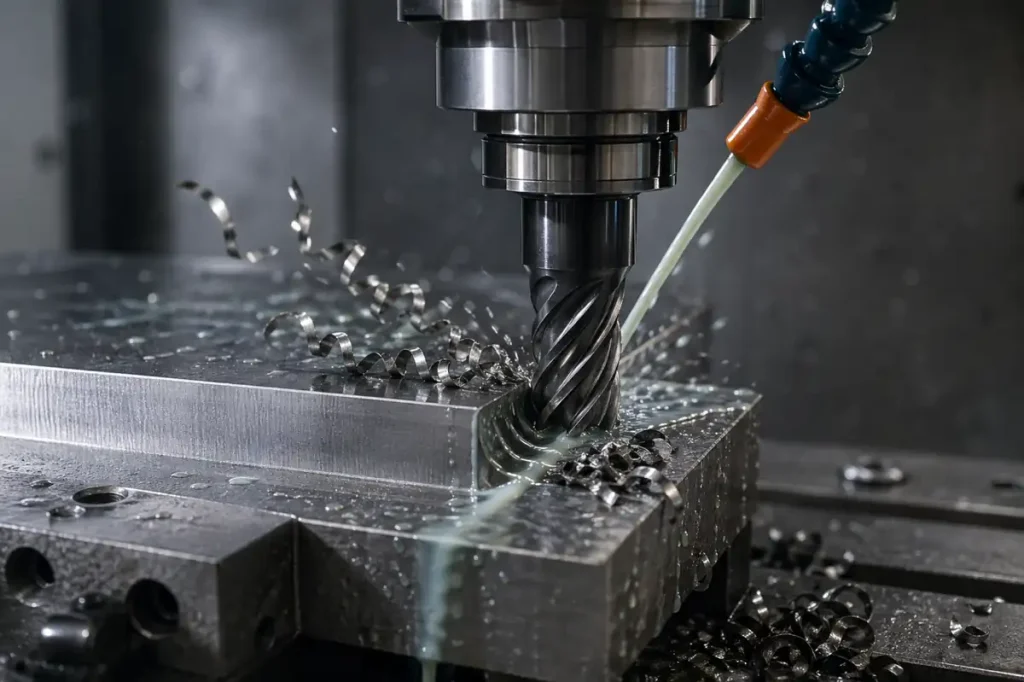
Ductility determines the shape of the chip formation. High-ductility materials do not break easily during cutting, often forming long, stringy chips. These “bird’s nests” can wrap around the spindle, causing downtime or scratching the finished surface of the part. Ideal materials have moderate brittleness, allowing chips to break into small, manageable pieces.
熱伝導率
Thermal conductivity dictates where the cutting heat goes. Aluminum has excellent conductivity, allowing heat to escape quickly with the chips. In contrast, titanium and nickel-based alloys have poor conductivity, causing heat to concentrate at the tool tip. This localized heat can soften the tool edge and lead to thermal expansion of the part, ruining dimensional accuracy.
Work Hardening
Certain materials, especially austenitic stainless steels, exhibit significant work hardening. This means the surface becomes instantly harder than the core as the tool passes over it. If the cutting speed or feed rate is inconsistent, or if the tool is not sharp enough, subsequent passes become extremely difficult and can lead to tool breakage.
Microstructure and Chemical Composition
The internal structure and chemical additives of a material change the machining experience. For instance, sulfur or lead is sometimes added to steel to improve chip breaking. Conversely, high silicon content in aluminum increases strength but also makes the material more abrasive, requiring more expensive diamond-coated tools.
| ファクター | How It Affects Machining | Impact on CNC Projects |
| 硬度 | Increases cutting force and friction | Shortens tool life; increases cost |
| Ductility | Leads to long, stringy chips | Poor surface finish; downtime risk |
| Conductivity | Low conductivity traps heat at the tool | Dimensional drift; requires high-pressure coolant |
| Work Hardening | Surface hardens during the cut | Requires rigid setups and constant feed rates |
How Is Machinability Measured?
Machinability is usually evaluated by observing practical results on the shop floor. Engineers generally look at tool life, the maximum achievable cutting speed, the resulting surface finish, and how well the material forms manageable chips. To simplify this, the industry uses a machinability rating, which is a relative value comparing a test material to a standard reference (usually AISI 1212 steel at 100%).
$$Machinability\ rating\ (\%) = \frac{Cutting\ speed\ of\ test\ material}{Cutting\ speed\ of\ reference\ material} \times 100$$
Machinability of Common CNC Materials
Selecting the right material requires a balance between mechanical performance, machining difficulty, and project cost. The table below gives a general comparison of common CNC materials. Actual machinability can vary depending on the specific grade, heat treatment condition, cutting tools, coolant, and machining parameters.
| 素材 | Typical Machinability | Machining Notes |
|---|---|---|
| アルミニウム6061 | 高い | Cost-friendly, fast to machine, and usually easy to achieve a good surface finish. |
| Aluminum 7075 | 高い | Stronger than 6061 while still offering good machining performance. |
| 真鍮 | 非常に高い | Excellent chip control, fast cutting speed, and low tool wear in most machining operations. |
| 銅 | ミディアム | Can be gummy and may require sharp tools and careful chip control. |
| 炭素鋼 | ミディアム | Generally predictable, but machinability varies with carbon content and heat treatment. |
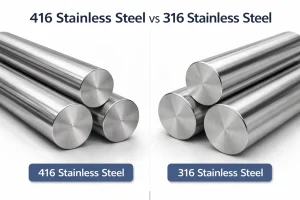
| Stainless Steel 304/316 | Low to Medium | Prone to work hardening and heat buildup; requires suitable tools and coolant control. |
| Tool Steel | 低い | High hardness and wear resistance make it slower and more demanding to machine. |
| チタン合金 | Very Low | Poor thermal conductivity concentrates heat near the cutting edge, increasing tool wear. |
| POM / Delrin | 高い | Machines well for precision plastic parts, but clamping force should be controlled to avoid deformation. |
| 覗き見 | ミディアム | Strong and heat-resistant, but expensive and sensitive to heat during machining. |
Does Part Design Affect Machinability?
Material is only one side of the coin. Even a highly machinable material like Aluminum 6061 can become a manufacturing nightmare if the part design is overly complex.
Common design features that decrease the “effective” machinability include:
- Deep Pockets: These require long tools that are prone to vibration and deflection.
- Thin Walls: These can warp or vibrate under cutting pressure, making tolerances hard to hit.
- シャープな内角: These require very small tools and slower speeds to avoid breakage.
- Tight Tolerances: Specifying ±0.01 mm when ±0.05 mm would work adds significant time and risk.
How to Improve Machinability
When part performance requirements demand a difficult-to-machine material, machinability can still be improved by adjusting the material condition, tooling strategy, and machining parameters.
- Material selection: Choose a more machinable grade when the application allows, such as using 303 stainless steel instead of 304 stainless steel.
- Material condition: Machine the material in a suitable condition whenever possible, such as using an annealed condition before final hardening or finishing.
- Tooling strategy: Use tool materials, coatings, and geometries designed for high heat, high wear, or work-hardening materials.
- Cutting parameters: Optimize cutting speed, feed rate, depth of cut, and chip load to reduce heat buildup and tool wear.
- Coolant and chip evacuation: Use suitable coolant delivery and chip control to avoid recutting, localized overheating, and surface damage.
- Tolerance review: Avoid unnecessary tight tolerances or complex features in non-functional areas.
- Supplier evaluation: Discuss material and design choices with your CNC supplier before production to reduce machining risk.
結論
The machinability of materials is a fundamental factor that affects every stage of a CNC project. While some metals like aluminum and brass are built for speed, others like titanium require a slower, more methodical approach.
The easiest material to machine is not always the best material for the part. The right choice is the one that meets all performance requirements while remaining practical and cost-effective. If you are unsure which material is suitable for your part, Minhe CNC can help review your drawings and suggest a practical machining approach to ensure your project is a success.