

In mechanical assemblies, both hex nuts and lock nuts are common, but they serve different purposes. A hex nut is mainly used for standard threaded connections, while a lock nut adds extra resistance against loosening.
Many lock nuts also have a hexagonal shape, so the real difference is not the appearance. The key difference is whether the nut has a built-in locking feature.
What Is the Difference Between a Lock Nut and a Hex Nut?
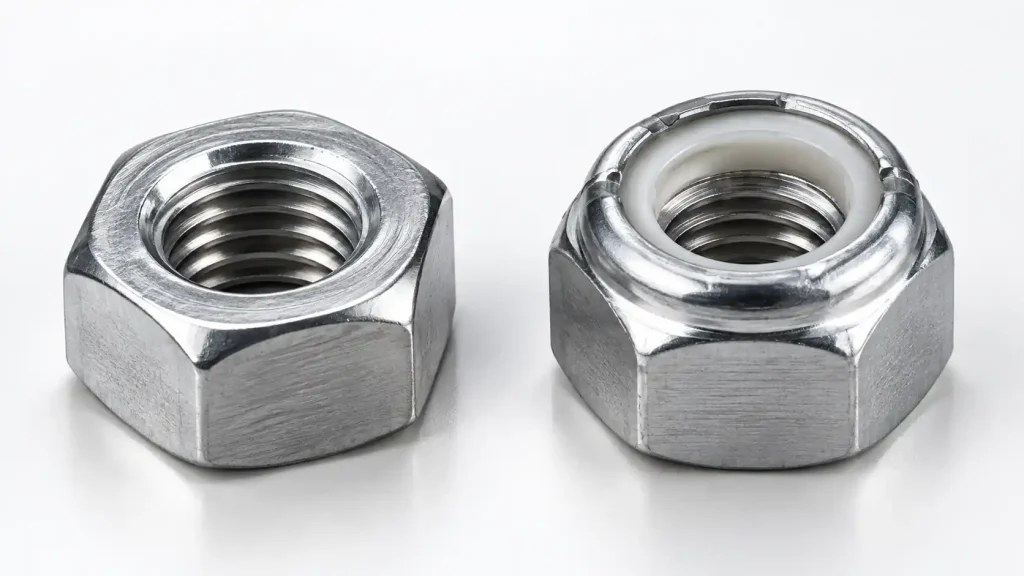
The most direct difference is that a standard hex nut usually has no built-in locking feature, while a lock nut uses a nylon insert, metal deformation, or another design to increase resistance to rotation.
| Feature | Hex Nut | Lock Nut |
|---|---|---|
| Main purpose | Standard threaded connection | Connection with added resistance to loosening |
| Locking feature | Usually none | Built in |
| Running resistance | Usually lower | Usually higher |
| Resistance to loosening | Mainly relies on normal clamping force | Nut itself adds extra resistance |
| Installation and removal | Easier | Usually requires more effort |
| Reuse | Generally easier | Depends on the type |
| Cost | Lower | Usually higher |
| Common use | General mechanical assemblies | Connections more likely to loosen |
In simple terms, a hex nut is more suitable for standard connections, while a lock nut adds an extra anti-loosening function.
What Is a Hex Nut?
A hex nut is one of the most common types of nuts.
The outside has six flat sides, so it can be installed with a wrench or socket. Internal threads mate with a bolt or stud to create a clamped connection. The threads may be produced using different thread machining methods depending on the part design and production volume.
Hex nuts have a simple design and usually do not include a dedicated locking feature. They are widely used on frames, brackets, housings, machine bases, and other general mechanical assemblies.
What Is a Lock Nut?
A lock nut, also called a locking nut, is a nut with an added anti-loosening feature.
The locking feature increases resistance to rotation, making the nut less likely to loosen under vibration or repeated movement.
A lock nut can help resist loosening, but it does not replace proper bolt preload. A reliable joint still depends on the bolt, nut, and joined parts maintaining enough clamping force.
Common Types of Lock Nuts
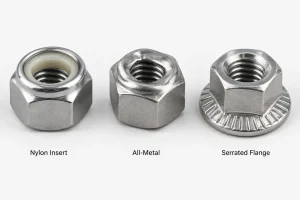
Lock nuts are available in several designs. The most common types include the following.
Nylon-Insert Lock Nut
A nylon-insert lock nut contains a nylon ring inside the nut.
As the bolt is threaded in, the nylon insert presses against the thread and increases friction. Nylon-insert lock nuts are simple, widely used, and common in general industrial equipment.
Nylon is more sensitive to heat and certain chemicals, so it is not suitable for every high-temperature application.
All-Metal Lock Nut
An all-metal lock nut does not use nylon. Instead, metal deformation is used to create locking resistance.
All-metal lock nuts are more suitable for high-temperature or demanding environments and are also common in automotive and industrial equipment.
Other Locking Designs
Some lock nuts use serrated flanges, deformed sections, or other mechanical features to resist loosening.
If your drawing calls for a lock nut, it is better to specify the exact type or applicable standard so the supplier does not select a different locking design.
How Are Lock Nuts and Hex Nuts Used Differently?
Hex nuts are simple, cost-effective, and easy to install or remove, so they are common in general mechanical connections.
Lock nuts add a locking feature and are more suitable for joints affected by vibration, shock, or repeated movement.
For example, hex nuts are often used on equipment brackets, mounting plates, and machine frames. Lock nuts are more common on motors, pumps, moving mechanisms, and other locations exposed to long-term vibration.
Lock Nut vs Lock Washer
Lock nuts and lock washers can both be used to help prevent loosening, but they work in different ways.
A lock nut includes the locking feature in the nut itself. A lock washer is a separate component installed under the nut or bolt head.
The two methods are different and are not directly interchangeable. The right choice depends on the joint design and assembly requirements.
Can Lock Nuts Be Reused?
That depends on the type of lock nut.
After repeated installation and removal, the nylon insert in a nylon-insert lock nut may wear and gradually lose locking resistance.
All-metal lock nuts do not contain nylon, but the metal section that creates resistance can also change after repeated use.
A lock nut that can still be threaded onto a bolt does not necessarily have the same locking performance as before. If your equipment is opened frequently, the reuse requirement should be confirmed in advance.
How Does Installation Torque Differ Between Lock Nuts and Hex Nuts?
A standard hex nut usually has relatively little running resistance before it clamps the joint.
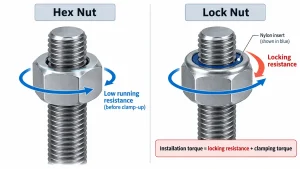
A lock nut creates extra resistance through its locking feature. During installation, part of the applied torque is used to overcome that resistance, while the rest is used to create clamping force.
A simple way to think about it is:
Lock nut installation torque = locking resistance + torque required to create clamping force
If you replace a standard hex nut with a lock nut, the original tightening torque may no longer be directly applicable. For parts with a defined clamping requirement, the tightening torque should be checked against the relevant fastener and assembly requirements.
How Do Material and Operating Conditions Affect the Choice?
Hex nuts and lock nuts are made from similar base materials, including carbon steel, stainless steel, and alloy steel.
Carbon steel is widely used because of its cost and strength range. Zinc plating, black oxide, or phosphate coatings can be added to improve surface performance. Stainless steel is more suitable for wet, outdoor, or corrosive environments. Higher-load joints may use heat-treated alloy steel.
For lock nuts, the locking feature also matters. Nylon-insert lock nuts are more sensitive to high temperatures, while all-metal lock nuts are usually more suitable for hotter environments.
What Should Be Specified on a Drawing or RFQ?
Writing only “M10 nut” is often not enough because the supplier still does not know whether you need a standard hex nut or a lock nut.
If you are preparing a machining drawing or RFQ, the following information should normally be included:
- Thread size
For example, M10×1.5.For machined components, it is also important to distinguish between tapped holes and threaded holes when defining the internal thread requirement. - Nut type
Such as a standard hex nut, nylon-insert lock nut, or all-metal lock nut. - Material and strength class
These should match the mating bolt and the load requirements. - Surface finish
Such as zinc plating, black oxide, or another corrosion-resistant finish. - Installation requirements
If the joint has a defined clamping requirement, the assembly method should also be stated. - Tool access
Leave enough space around the part for a wrench or socket.
European projects commonly use ISO metric fasteners, while US projects may also use inch-series threads and ASME standards. If your parts are supplied to both European and US markets, the thread system and fastener standard should be clearly stated on the drawing.
When Does a Standard Nut Need CNC Machining?
Most standard hex nuts and lock nuts are mass-produced parts, so buying a standard fastener is usually cheaper than CNC machining one.
Custom machining is more useful when standard parts cannot meet the design requirements, for example:
- Special threads
- Large-diameter nuts
- Extra-thin designs
- Non-standard external shapes
- Special materials
- Small prototype quantities
- High-precision internal threads
- Integrated parts that combine the nut with other machined features
These custom parts can be produced by CNC turning, CNC milling, thread cutting, or thread milling.
Internal threads may also require different thread taps depending on the material, hole type, and thread specification.
If you are designing a non-standard nut, an internally threaded machined part, or a component that does not work with an off-the-shelf fastener, you can provide a drawing or 3D file. We can review the thread, material, dimensions, and machining requirements and determine which features can use standard fasteners and which require custom CNC machining.
How Do You Choose Between a Lock Nut and a Hex Nut?
The main question is whether the connection needs extra resistance against loosening.
A hex nut is common for standard fixed connections. If the joint is exposed to significant vibration, shock, or long-term movement, and loosening could affect equipment performance, a lock nut may be more suitable.
Once a lock nut is required, the specific type can be selected based on temperature, material, maintenance frequency, and operating environment.
Frequently Asked Questions
Is a Lock Nut Always Hexagonal?
No. “Hex” describes the shape, while “lock” describes the function. Many lock nuts are hexagonal, but other designs also exist.
Can Any Bolt Be Used With a Lock Nut?
No. Thread diameter, pitch, and thread system must match. For example, M10×1.5 and M10×1.25 are not interchangeable.
Is a Lock Nut the Same as a Jam Nut?
No. A lock nut has a built-in feature that helps resist loosening. A jam nut is usually thinner and is often used together with another nut to create a locking effect.
Conclusion
Hex nuts and lock nuts are both used in threaded connections, but they serve different purposes. Hex nuts are simple and suitable for general mechanical assemblies, while lock nuts add extra resistance against loosening.
For custom machining projects, the drawing should clearly state the nut type, thread size, material, strength class, and surface finish. Standard nuts should normally be purchased when they meet the design requirements. CNC machining is more suitable when the part requires a special size, material, thread, or non-standard structure.