
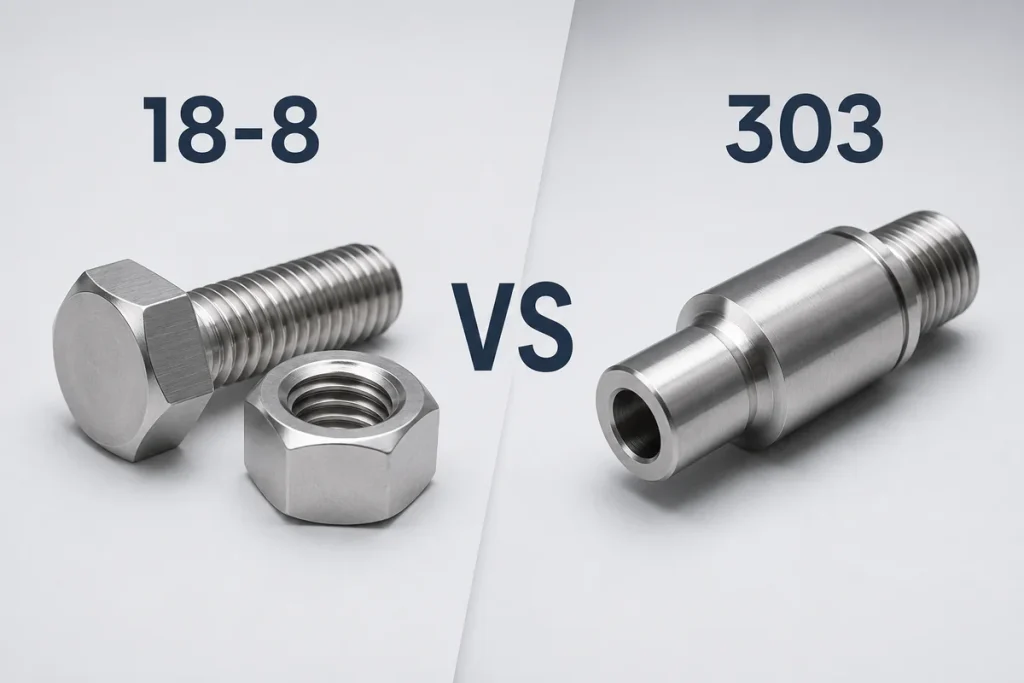

In stainless steel CNC machining, material selection directly affects cutting efficiency, tool wear, corrosion resistance, and final part cost. 18-8 stainless steel and 303 stainless steel are both common austenitic stainless steels, but they are usually chosen for different project requirements. This article compares them across material definitions, machining characteristics, and application scenarios to help you determine the most suitable option for your part design.
What is 18-8 Stainless Steel?
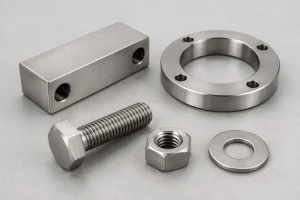
18-8 stainless steel is a general industry term referring to austenitic stainless steel containing approximately 18% chromium and 8% nickel, often including grades such as 304 and 305. Because of its stable supply and predictable properties, it is usually selected for standard fasteners, brackets, general hardware, and structural components where corrosion resistance and material availability are more important than machining speed.
What is 303 Stainless Steel?
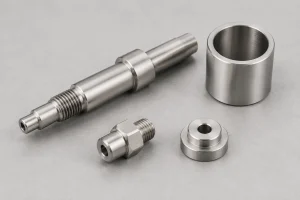
303 stainless steel is a free-machining austenitic grade, commonly selected for CNC turned parts, threaded components, shafts, bushings, and automatic lathe work. By incorporating a controlled amount of sulfur, this grade is designed to facilitate better chip breaking during machining, which can assist in stabilizing production cycles for turned components.
Differences Between 18-8 and 303 Stainless Steel
18-8 stainless steel is usually selected for general corrosion resistance, formability, and material availability. 303 stainless steel is usually selected for machinability, chip control, and high-volume CNC turning or automatic lathe work.
| Comparison Item | 18-8 Stainless Steel | 303 Stainless Steel |
| Material type | General 18-8 austenitic stainless steel term | Specific free-machining stainless steel grade |
| Composition focus | Chromium-nickel balance | Added sulfur for machinability |
| Machinability | Moderate; tougher chip control | Better; easier cutting and chip breaking |
| Corrosion resistance | Generally better | Lower than 18-8 / 304-type grades |
| Strength | Similar basic strength range | Similar strength, lower ductility possible |
| Cost impact | Stable cost for standard parts | Lower machining cost in high-volume turning |
To better understand these differences, the following sections explain each factor in more detail.
Composition
18-8 stainless steel maintains standard chromium-nickel ratios to ensure stability in most service environments. 303 stainless steel intentionally adds sulfur to the formulation; while this improves mechanical cutting characteristics and chip breaking, it introduces micro-inclusions that generally lower corrosion resistance compared to 18-8 or 304-type grades.
Machinability
Machinability is the core differentiator in CNC operations. 303 usually offers easier chip breaking, smoother turning, and better cycle stability than 18-8 / 304-type stainless steel. 18-8 can still be machined, but it may require more careful tooling, specific cutting parameters, and active chip control to manage tougher, stringy chips.
Corrosion Resistance
The sulfur content in 303 can affect its performance in corrosive environments. If the part is intended for humid, outdoor, cleaning, or mildly corrosive environments, 18-8 / 304-type stainless steel is usually more reliable. If the operating environment is controlled and machining efficiency is the primary concern, 303 may be considered.
Strength
Both 18-8 and 303 stainless steels are austenitic, so their basic strength levels are usually close in many general applications. Since 18-8 is a general term rather than a single grade, the values below use 304 / 18-8 type stainless steel as a common reference.
| Property | 304 / 18-8 Type Stainless Steel | 303 Stainless Steel |
| Tensile strength | About 515 MPa | About 515–620 MPa |
| Yield strength | About 205 MPa | About 240–275 MPa |
| Elongation | About 40 % | About 35–50 % |
| Hardness | Up to about HB 201 | About HB 183–241 |
These values are reference ranges and may vary by standard, supplier, material condition, and cold working. For CNC machining projects, the primary difference is usually machinability and corrosion resistance rather than basic strength.
Cost
303 may reduce total machining cost in high-volume turned parts because easier cutting can reduce cycle time, tool wear, and chip-control issues. For simple standard hardware or lightly machined parts, 18-8 may remain more economical due to its wide availability and lower raw material cost.
18-8 and 303 Stainless Steel: Which is Better?
There is no absolute better choice; the decision depends on your specific project requirements. If you prioritize versatility, corrosion resistance, or standard parts, 18-8 stainless steel is usually more appropriate:
- The part is used in humid, outdoor, or mildly corrosive environments.
- The project involves extensive welding, bending, or deep drawing.
- You need to procure large quantities of standard fasteners.
- The part’s primary function is structural support rather than precision mechanical mating.
If you prioritize production efficiency, precision machining, or automation, 303 stainless steel is usually better:
- The core process involves CNC turning, milling, or automatic lathe production.
- The part geometry is complex, and strict chip control is required.
- You wish to lower overall labor and tooling costs by increasing cycle speeds.
- Corrosion resistance requirements are moderate and the operating environment is controlled.
Applications of 18-8 Stainless Steel
18-8 stainless steel is widely used in various foundational and structural engineering fields where environmental durability and general versatility are prioritized:
- Fasteners and hardware: Used for bolts, nuts, screws, washers, and brackets that need general corrosion resistance and stable material availability.
- Food and medical equipment: Utilized for parts that require non-reactive surfaces and where machining speed is less critical than corrosion resistance.
- Architectural components: Employed in outdoor decorative support components and structural frameworks exposed to the atmosphere.
- General mechanical parts: Suitable for basic structural frames and connection brackets that do not require complex, high-speed CNC machining or intricate geometric shaping.
Applications of 303 Stainless Steel
303 stainless steel is a common material for precision manufacturing where high-efficiency cutting and complex geometries are required:
- Automatic lathe components: Ideal for mass-produced parts that benefit from excellent chip breaking and high processing speeds, reducing overall cycle time.
- Precision shafts and bushings: Widely used for CNC-turned shafts, pins, and sleeves where dimensional precision and high-quality surface finishes are paramount.
- Valve internals: Commonly applied for stems, regulators, and precision internals that require intricate shaping and tight-tolerance threads.
- Fittings and connectors: Used for hardware that requires frequent cutting, threading, and machining to achieve complex interface geometries.
Stainless Steel CNC Machining Support
For stainless steel CNC machined parts, material selection should be reviewed together with part geometry, tolerance requirements, machining volume, surface finish, and service environment. Minhe can support material and process review for 18-8 / 304-type stainless steel, 303 stainless steel, and other stainless steel grades.
- Material selection support: Review whether 18-8 / 304-type stainless steel or 303 stainless steel is more suitable for the part application.
- Machining process support: Support CNC turning, milling, drilling, threading, and small precision stainless steel components.
- Manufacturing feedback: Review tolerance, surface finish, tool access, chip control, and cost factors before production.
Conclusion
18-8 stainless steel is generally preferred when corrosion resistance, availability, and general-purpose use are more important. 303 stainless steel is usually selected when machinability, chip control, and turning efficiency have a greater impact on production cost. For CNC machined stainless steel parts, the better choice depends on the service environment, part geometry, machining process, and order volume.
If you need help choosing stainless steel for CNC machined parts, Minhe can review your drawings and support material and process evaluation.
FAQ
Is 303 stainless steel the same as 18-8 stainless steel?
No. 18-8 stainless steel is a broad term for austenitic stainless steels with about 18% chromium and 8% nickel. 303 stainless steel is a specific free-machining stainless steel grade with added sulfur to improve chip breaking and machinability.
Is 18-8 stainless steel the same as 304 stainless steel?
In many commercial applications, 18-8 stainless steel often refers to 304-type stainless steel, especially for standard fasteners and general hardware. However, 18-8 is not always a single exact grade, so engineering projects should confirm the required material standard or material certificate.
Will 18-8 stainless steel rust?
18-8 stainless steel has good general corrosion resistance, but it is not completely rust-proof. It may still rust or discolor under salt spray, chloride exposure, poor cleaning, long-term moisture, or harsh service conditions.