

Manufacturing parts with side holes, complex side geometry, or cylindrical profiles often requires specialized approaches in CNC machining. When a part needs more access than standard 3-axis milling provides but does not necessarily require a full 5-axis setup, 4-axis machining is often a practical option.
By adding a controlled rotary axis, the machine can reach side holes, radial slots, circumferential grooves, angled faces, and multiple machined surfaces with fewer manual setups. This article explains what 4 axis machining is, how it works, the main types of 4 axis machining, its advantages and limitations, and the parts commonly suited for this process.
What Is 4 Axis Machining?
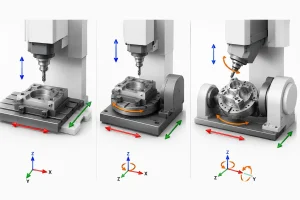
4 axis machining is a CNC machining method that adds one rotary axis to the standard X, Y, and Z linear axes. This additional rotary axis allows the workpiece to rotate during the machining process, enabling the cutting tool to reach multiple faces, side features, or circular geometry within fewer setups.
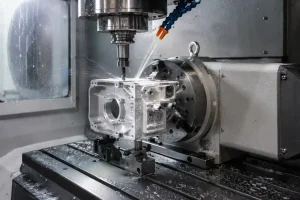
This does not mean every part should use 4-axis machining. It is most useful when the geometry requires side access, angular positioning, or rotary features that would otherwise need repeated removing, flipping, indicating, and re-clamping on a 3-axis machine. This configuration may help streamline the production of parts that would traditionally demand frequent manual re-fixturing or complex indexer setups.
How Does 4 Axis Machining Work?
Most 4-axis machining projects begin with a CAD model and CAM programming, but the defining feature of the process is how the rotary axis is used during machining. In a 4-axis setup, the workpiece is mounted on a rotary table, indexer, or fourth-axis fixture. The CNC program controls the X, Y, and Z linear movements while also controlling the rotation of the fourth axis. This allows the part to be repositioned or rotated without being removed from the fixture, changing its orientation relative to the spindle during the program cycle.
To achieve this, the system balances linear toolpaths with controlled part orientation:
-
Linear cutting movement: The cutting tool moves along the X, Y, and Z axes to perform milling, drilling, or slotting operations while acting on the exposed face.
-
Rotary positioning: The fourth axis rotates the workpiece to a required angle so that another face or specific radial feature can be presented to the machine spindle.
-
Single-setup access: Multiple sides, side holes, slots, or circular features can often be machined sequentially without the operator performing manual re-fixturing.
-
Datum control: Because the part remains clamped during rotation, the relationship between different machined features across different faces is easier to track and verify.
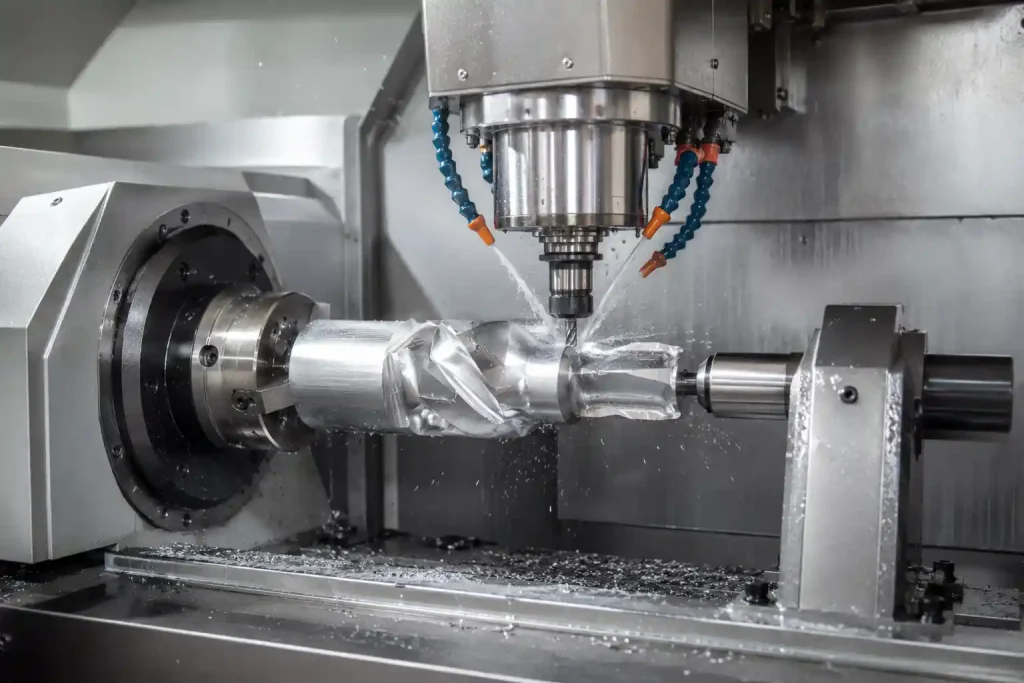
The fourth axis can be used for both indexed positioning and continuous rotation. In indexed machining, the workpiece rotates to a fixed angle before cutting begins and locks in place. In continuous machining, the rotary axis moves at the same time as the cutting tool, which is useful for cylindrical contours, helical grooves, and wrapped features.
What Does the Fourth Axis Do?
The fourth axis provides a controlled means of reorienting the workpiece relative to the spindle. By rotating the part around a specific axis—most commonly the X-axis—the machine changes the angle of the workpiece relative to the cutting tool, gaining the ability to reach surfaces that would otherwise be obscured by the work-holding device.
This capability is useful for parts requiring side holes, circumferential grooves, angled faces, or features distributed across multiple surfaces of a single block. Because the part remains clamped during rotation, the fourth axis helps maintain positional consistency between these different features. It reduces the reliance on manual flipping and secondary positioning, which helps prevent alignment errors that can occur during multi-stage 3-axis machining.
Types of 4 Axis Machining
4-axis machining is categorized based on how the rotary axis interacts with the cutting tool. The two primary methods are indexed and continuous machining.
Indexed 4 Axis Machining
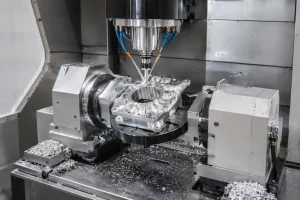
Indexed 4-axis machining, sometimes referred to as 3+1 machining, involves rotating the workpiece to a specific angle and locking it in place. Once the desired angle is achieved, the rotary axis remains stationary while the machine performs standard milling, drilling, or slotting operations.
This method is commonly used for parts that require features on multiple sides, such as mounting holes or flat facets. Because the axis is locked during the cut, the setup provides better rigidity during cutting and is often straightforward to program. It is a commonly used option for components like housings, brackets, and various tooling plates where accurate angular positioning is required.
Continuous 4 Axis Machining
Continuous 4-axis machining involves the synchronized movement of the rotary axis and the linear axes during the cutting process. In this setup, the workpiece rotates while the tool is actively milling the material, allowing for the creation of complex, curved, or wrapped features.
This technique is commonly used for machining features like helical grooves, cams, and cylindrical contours where the tool path follows the curvature of the part. Because the motion requires synchronization between the machine axes, it requires careful planning in the CAM environment to verify the toolpath accuracy and reduce interference risk.
Advantages of 4 Axis Machining
The primary benefit of 4-axis machining is the ability to consolidate multiple operations into a single setup, which provides several operational advantages for production. 4-axis machining is not automatically better for every part, but it can be more practical when a component requires side features, rotary geometry, or fewer setups without the complexity of a full 5-axis process.
-
Fewer setups: The operator does not need to remove, flip, indicate, and re-clamp the part for each side feature, which can reduce setup time and handling variation.
-
Better positional consistency: Features on different faces can be machined from the same datum reference, reducing the risk of stacked setup error.
-
Improved access to side features: Side holes, radial slots, angled faces, and circular features can be presented to the spindle by rotating the workpiece instead of building several separate fixtures.
-
More efficient multi-side machining: Reducing manual re-fixturing can shorten setup and machining time for parts with several machined faces.
-
Practical for medium-complexity parts: It can be useful for parts that need more access than 3-axis machining provides but do not require continuous tool tilting or full 5-axis capability.
Limitations of 4 Axis Machining
While versatile, 4-axis machining has specific constraints that should be considered during the process planning stage, as it does not replace every multi-axis strategy.
-
Only one rotary axis: Because there is only one rotational degree of freedom, it cannot perform complex multi-axis operations that require the tool to tilt into compound angles.
-
Fixture clearance and work envelope must be checked: A rotary table, indexer, or fourth-axis fixture takes space inside the machine. In some cases, the fixture solves the access problem but creates a new clearance problem between the tool, chuck, rotary table, and machine enclosure. Large parts or side-access features require fixture and clearance review before machining.
-
More complex CAM programming: Continuous 4-axis paths require more advanced software and verification than standard 3-axis work to ensure there are no collisions between the tool, the part, and the fixture.
-
Not always cost-effective for simple parts: For flat or simple geometries that can be finished in a single 3-axis setup, the additional overhead of 4-axis equipment may not be necessary.
-
Limited for complex freeform geometry: Highly intricate freeform surfaces or deep, multi-directional cavities may still exceed the capabilities of a 4-axis machine, potentially requiring other machining strategies.
Whether or not 4-axis machining is the right path should be evaluated based on the specific part geometry, required tolerances, material, batch size, and the need for machined surface precision.
Suitable Parts and Applications of 4 Axis Machining
4-axis machining is often reviewed when part geometry demands access to multiple sides, circular features, or specific angular relationships.
-
Brackets and housings: Useful when bolt holes, mounting faces, or side features are located on multiple faces, requiring rotation for tool access.
-
Shafts and sleeves: Suitable for grooves, slots, keyways, or wrapped features machined directly onto cylindrical surfaces.
-
Valve bodies and manifold-like parts: Useful when ports or machined faces must stay aligned and maintain positional relationships across different sides of the component.
-
Fixture and tooling components: Suitable when multiple reference features must be machined from a single setup to prevent the stacking of positioning errors.
-
Compact precision components: Small machined parts with radial holes, curved slots, side ports, or several aligned faces are often reviewed for 4-axis machining, especially when repeated re-fixturing could affect feature relationships. These components may appear in robotics, automotive, aerospace, or medical device assemblies.
Conclusion
4-axis machining is most useful when a part has side holes, cylindrical features, multi-face geometry, or setup-related tolerance risks. Early drawing review can help confirm whether the geometry, tolerance requirements, material, batch size, and machined surface requirements justify a 4-axis approach.