

Machined parts carry residual cutting fluid, metal chips and oil on their surfaces after turning, milling or five-axis machining. If these residues are not removed, they cause errors in dimensional inspection, contaminate packaging during transport and ultimately affect the customer’s assembly. Cleaning is therefore a critical step in ensuring delivery quality. This article covers why cleaning matters, the standard process, material differences, common mistakes and how manufacturers put cleaning into practice.
Why Cleaning Machined Parts Matters
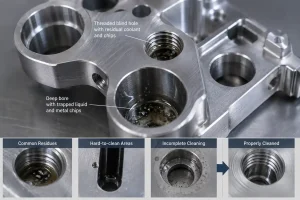
Cleaning directly affects the functional quality of a part and the customer’s acceptance result. Cutting fluid left on a part surface for a long time forms corrosion spots, particularly on aluminum and steel parts; fine metal chips can become embedded in threads or moving mating surfaces and cause assembly jamming. In addition, liquid trapped in blind holes can seep out slowly during transport and storage, leaving customers with the impression that the part is leaking or contaminated. These are not purely cosmetic issues; they are functional defects that affect dimensional accuracy, assembly efficiency and product life.
Residual contaminants affect parts mainly in the following ways:
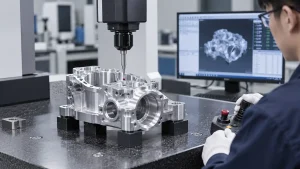
- Chips attached to datum surfaces cause CMM measurement values to deviate.
- Chemicals in cutting fluid react with materials such as aluminum and copper, causing oxidation and discoloration.
- Oil in threaded blind holes changes tightening torque and affects the quality of fastened assemblies.
- Moisture inside packaging combined with residual contaminants causes rust or white spots during transport.
Cleaning is not an optional finishing task; it is a quality assurance step that must be performed before delivery. With that understood, we now move on to the specific process.
CNC Machined Parts Cleaning Process
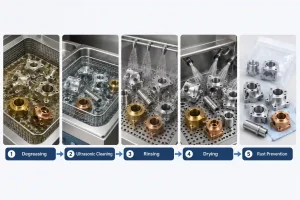
Although part shapes, materials and machining methods differ, the cleaning of the vast majority of machined parts can be summarized in five steps. Performed in sequence, these steps remove the various machining residues and protect the part surface for a longer period. Cleaning should be arranged as soon as possible after machining so that contaminants do not remain on the part surface for too long.
Degreasing
Degreasing is the first step of cleaning. Its purpose is to remove cutting fluid, lubricating oil and heavy oil contamination from the part surface. Common methods include solvent immersion, spray rinsing and ultrasonic pre-cleaning. For heavily contaminated parts, an industrial degreaser can be used for the first pass, followed by a cleaner to remove the remaining oil film. The degreaser must be selected according to the part material; for example, aluminum parts should avoid strong alkaline formulas that can damage the surface oxide layer.
Ultrasonic Cleaning
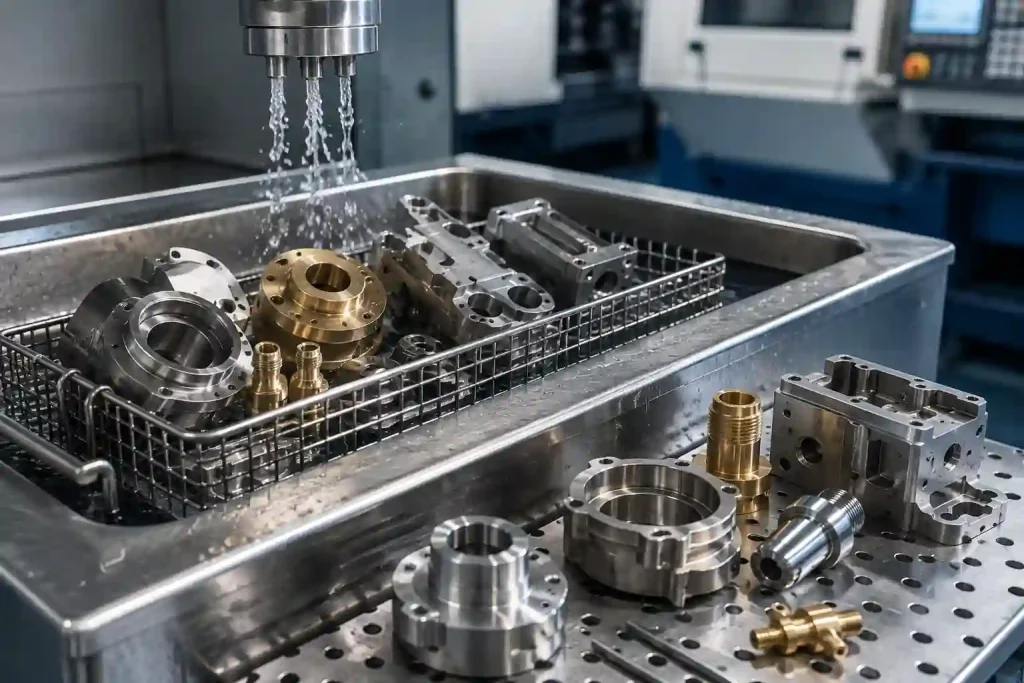
Ultrasonic cleaning is the most commonly used and most reliable method for machined parts. High-frequency vibration in the cleaning tank generates cavitation bubbles whose collapse strips chips and oil films from tiny gaps, blind holes and threads. The cleaning solution temperature is typically around 50°C, with cleaning times of 5 to 15 minutes. Parts should not be stacked too densely in the cleaning basket, or covered areas will not be cleaned effectively.
Rinsing
After ultrasonic cleaning, the part surface carries cleaning solution containing contaminants and must be rinsed off. Rinsing can be done by immersion or high-pressure spraying; for parts with deep holes and threaded holes, high-pressure spraying removes residual liquid more effectively. Using pure or deionized water rather than ordinary tap water reduces water spotting, especially for aluminum and copper parts. Rinse water should be kept flowing or changed regularly so that rising contaminant concentration does not reduce rinsing effectiveness.
Drying
Cleaned parts must be dried promptly; residual moisture forms water marks on metal surfaces and can even cause rust. Common drying methods include compressed air blowing, hot-air circulation ovens and conveyor dryers. When using compressed air, the air supply must be filtered and dehumidified; otherwise, uncleaned air carries oil and water back onto the part surface. Drying temperature should be set according to the material: aluminum parts should not exceed 80°C, and copper parts are best kept below 70°C to prevent high-temperature oxidation.
Rust Prevention
Parts that will not be packed or shipped immediately after drying should receive rust prevention treatment. Options include applying rust preventative oil, using VCI (vapor corrosion inhibitor) paper and heat-sealed rust protection bags. Rust preventative oil should cover all machined surfaces uniformly, especially finished faces and internal bores touched by tools. For parts that will later be assembled or further processed, choose a rust preventative that does not affect subsequent operations. Properly protected parts stay clean and bright during storage and transport.
These five steps cover the routine cleaning needs of CNC machined parts. However, the chemical properties of different materials vary significantly, and both the choice of cleaning agent and process parameters differ accordingly, which is covered next.
Cleaning Methods by Material
Aluminum, steel and copper are the three most common materials in CNC machining, and their corrosion resistance and chemical activity differ. If material differences are ignored during cleaning, the result can range from surface discoloration to dimensional failure of the part. Material is therefore the first factor to consider when selecting a cleaning approach.
Aluminum Parts
Aluminum parts have a dense natural oxide film that provides corrosion resistance. Strong alkaline cleaners dissolve this film and produce white corrosion spots on the surface, while strong acids can cause pitting of the aluminum substrate. Aluminum parts should therefore be cleaned with neutral or weakly alkaline cleaners, ideally with a pH of 8 to 9. Ultrasonic cleaning time should not be excessive, especially for thin-walled aluminum parts, to avoid over-cleaning that changes surface roughness. Rinsing and drying should follow promptly, or water marks will leave difficult-to-remove stains.
Steel Parts
The biggest risk for carbon and alloy steel parts after cleaning is rust. Alkaline degreasers or solvents can be used on steel parts, but drying and rust prevention must follow as soon as cleaning is complete. In humid conditions, cleaned steel parts can develop light rust within hours, so reliable drying is essential. Adding a rust inhibitor to the cleaning solution or applying rust preventative oil immediately after cleaning is recommended. For European orders shipped by sea, steel parts should also be sealed in VCI bags before packaging.
Copper Parts
Copper and copper alloys are sensitive to sulfides, ammonia compounds and strong oxidizers and will discolor when exposed to them. Ammonia-containing cleaners cause dark spots on copper surfaces and should be avoided. Weakly alkaline or neutral cleaners are the safer choice for copper parts. If a bright surface must be maintained after machining, a light citric acid passivation can be applied after cleaning, but it must be thoroughly rinsed to avoid acid residue. Drying temperature should not be too high, or the copper surface will visibly oxidize.
The table below summarizes the key differences for the three materials for quick reference:
| Material | Recommended Cleaner | Substances to Avoid | Drying & Rust Prevention |
|---|---|---|---|
| Aluminum | Neutral or weakly alkaline cleaner | Strong alkali, strong acid, chlorinated solvents | Dry promptly to avoid water marks |
| Steel | Alkaline degreaser or solvent-type cleaner | Acidic cleaners (cause flash rust) | Rust prevention immediately after drying; use VCI bags |
| Copper | Weakly alkaline or neutral cleaner | Ammonia and oxidizing cleaners | Temperature below 70°C; passivation optional |
Choosing the right cleaning method by material is the basis for avoiding scrapped parts, but some common operational errors are easy to overlook in production. The following mistakes are worth the attention of both operators and buyers.
Common Cleaning Mistakes
An incorrect cleaning method can sometimes cause more damage than no cleaning at all. Contamination can be removed by cleaning, but surface damage and corrosion are often irreversible once they occur. Understanding the common mistakes in cleaning is therefore an important part of quality control.
- Mismatched cleaner and material. This is the most common problem. Strong alkali on aluminum parts causes blackening and corrosion within minutes, while chlorinated solvents on copper parts cause discoloration. Cleaner compatibility with the material must always be confirmed before cleaning.
- Ultrasonic cleaning for too long. Longer cleaning time is not necessarily better. Aluminum and copper parts left in the ultrasonic tank too long can suffer excessive surface corrosion and even dimensional changes in thin-walled sections. Cleaning time should be set based on test pieces and standardized in the process.
- Unfiltered compressed air. Compressed air that is not free of oil and water blows moisture and oil back onto the part surface. Before using air for drying, check that the air source filters are working and drain condensate from the lines regularly.
- Ignoring residue in blind holes and deep bores. Liquid in blind holes does not flow out easily during normal rinsing and leaves water marks or crystallized deposits after drying. Such parts require a combination of ultrasonic cleaning and high-pressure blowing to ensure residual liquid is fully expelled.
After avoiding these mistakes, buyers should also understand how suppliers ensure cleaning quality at the source. Only when cleaning is built into a standardized production process can surface problems at the customer end be truly avoided.
How a Manufacturer Ensures Part Cleanliness
MinHe CNC Machining treats cleaning as the final basic step before delivery, not an option. After machining, parts enter the cleaning area and pass through degreasing, ultrasonic cleaning, pure-water rinsing and filtered compressed-air drying in accordance with the process card. Operators verify the compatibility of material and cleaning agent before starting, and cleaning parameters are recorded for every batch.
Cleaned parts then move to the inspection area, where a coordinate measuring machine (CMM) checks critical dimensions to confirm that cleaning has not affected part accuracy. Parts then receive a final visual inspection to confirm there is no residue, scratching or rust before rust-preventative packaging. The same process applies to cast blanks that require machining; after turning and milling, the cleaning standard is identical to regular CNC machined parts. MinHe’s business focuses on CNC turning, milling and five-axis machining, and the company does not offer anodizing, plating or other surface treatment, but cleaning remains a guaranteed step for every part shipped.
Conclusion
Cleaning machined parts is a systematic task involving multiple steps, from degreasing, ultrasonic cleaning and rinsing to drying and rust prevention, and each step has its own process requirements. Different materials require different cleaning agents, cleaning times and rust prevention strategies. For buyers, understanding these steps helps in judging a supplier’s quality control capability and avoids assembly and production delays caused by insufficient cleanliness.
MinHe CNC Machining has integrated cleaning into its standard process, followed by CMM dimensional inspection and rust-preventative packaging, so every delivered part is clean, dimensionally accurate and protected. If you are looking for a reliable CNC machining partner, or would like to learn more about our cleaning and quality control processes, please contact us directly. The following answers cover three common questions.
Frequently Asked Questions
How long does ultrasonic cleaning take?
Ultrasonic cleaning typically takes 5 to 15 minutes, depending on part complexity and the type of contamination. Parts with deep holes, blind holes or threads can be cleaned longer, but aluminum and copper parts should generally stay within 10 minutes to avoid excessive surface corrosion. After cleaning, parts must be thoroughly rinsed with pure or clean water and then dried.
How soon will parts rust after cleaning?
This depends on the material, ambient humidity and rust prevention measures. Carbon steel can show rust within hours in a humid environment, so rust prevention should be applied immediately after drying, such as rust preventative oil or sealing in VCI bags. Aluminum and copper are more stable, but they should also be sealed within 24 hours after cleaning and packaging to reduce moisture risk.
Can ultrasonic cleaning damage part surfaces?
Normally, no. Ultrasonic cleaning removes contaminants through cavitation and does not mechanically damage the metal substrate. However, if the cleaning solution is unsuitable, the temperature is too high or the cleaning time is excessive, aluminum and copper parts can show discoloration or slight corrosion. As long as process parameters are set according to the material, ultrasonic cleaning is a safe and effective cleaning method.