
Many people know that copper and aluminum can conduct electricity, but they may be less sure about iron. Iron is commonly used in mechanical structures, tools, equipment parts, and metal housings, so it often looks more like a structural material than a dedicated conductive material.
So, can iron conduct electricity?
Below, we explain iron conductivity in simple terms and answer several related questions, including whether iron is a good conductor, whether solid iron and cast iron can conduct electricity, and whether iron can also conduct heat.
Does Iron Conduct Electricity?
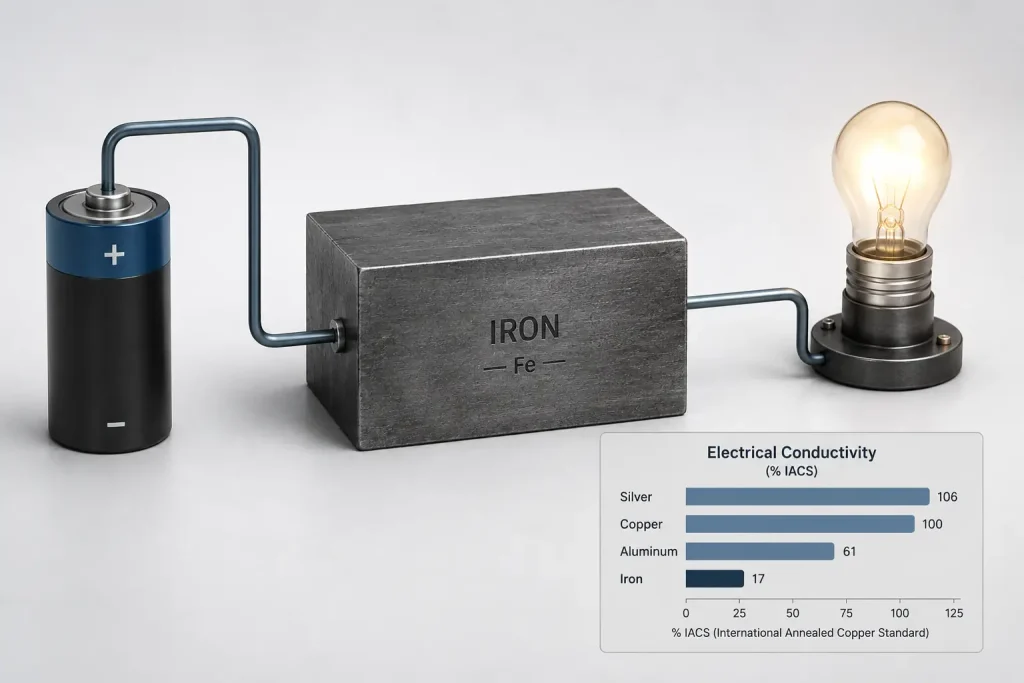
Iron can conduct electricity. It is a conductor, not an insulator. Iron is a metal, and it contains electrons that can move through the material. When voltage is applied across an iron part, these electrons move and allow electrical current to pass through the metal.
However, whether iron is considered a good conductor depends on what it is compared with. Compared with non-metallic materials such as plastic, rubber, glass, and ceramic, iron conducts electricity well. But compared with copper, silver, and aluminum, iron has lower electrical conductivity and higher electrical resistance. In simple terms, iron is conductive, but it is not one of the best metals for high-efficiency electrical conduction.
Does Iron Conduct Heat?
Iron can also conduct heat. Like many metals, iron contains free electrons that can help transfer both electrical charge and thermal energy, so iron can conduct both electricity and heat.
However, iron does not conduct heat as efficiently as copper or aluminum. Copper and aluminum transfer heat faster, so they are more commonly used in heat sinks, electronic housings, heat exchangers, and other parts that require quick heat dissipation. Iron can conduct heat, but it is usually chosen more for strength, wear resistance, magnetic properties, dimensional stability, and cost than for thermal conductivity.
What Are the Top 10 Most Conductive Metals?
Among common engineering metals, silver usually has the highest electrical conductivity, followed by copper and gold. Copper is one of the most widely used conductive metals in industry because it offers high conductivity, reasonable cost, and mature processing and joining methods. Aluminum has lower conductivity than copper, but it is lightweight and commonly used in power transmission, housings, and heat dissipation parts.
| Rank | 金属 | Conductivity Feature | Common Applications |
|---|---|---|---|
| 1 | 银色 | Highest conductivity, but high cost | Special electrical contacts, high-performance conductive parts |
| 2 | 铜 | Very high conductivity, widely used in industry | Wires, terminals, busbars, connectors |
| 3 | 金色 | High conductivity and excellent corrosion resistance | Precision electronic contacts, plating |
| 4 | 铝质 | Good conductivity and lightweight | Power transmission, housings, heat sinks |
| 5 | Tungsten | Conductive with excellent high-temperature resistance | Electrodes, filaments, high-temperature parts |
| 6 | 锌 | Conductive and commonly used as a coating material | Galvanized coatings, die cast parts, corrosion protection coatings |
| 7 | 镍 | Moderate conductivity and good corrosion resistance | Plating, alloys, battery components |
| 8 | 铁 | Conductive, but not highly efficient | Structural parts, magnetic parts, mechanical components |
| 9 | Platinum | Conductive and stable, but expensive | Special electrical, chemical, and sensor applications |
| 10 | 锡 | Moderate to low conductivity, often used as an auxiliary material | Solder, coatings, electronic connection support |
This order is better understood as a reference ranking for common engineering metals, not an absolute physical ranking. Metal conductivity can vary with purity, temperature, alloy composition, and testing conditions.
Do Solid Iron and Cast Iron Conduct Electricity?
Solid iron can conduct electricity. At room temperature, iron is a solid metal, and it still contains electrons that can move through the material. This means electrical current can pass through solid iron. In other words, iron does not need to be molten to conduct electricity; ordinary solid iron is already a conductor.
Cast iron can also conduct electricity because it is an iron-based material. However, cast iron is different from pure iron. It contains a higher amount of carbon, and its internal structure may include graphite flakes, graphite nodules, carbides, or other phases. These features can affect how efficiently current passes through the material, so cast iron is usually not considered a high-conductivity material.
In practical applications, cast iron is more often used for machine bases, pump housings, brackets, cylinder blocks, brake parts, and wear-resistant components. Its value mainly comes from rigidity, vibration damping, wear resistance, castability, and cost rather than strong electrical conductivity.
Applications of Iron Conductivity
Iron can conduct electricity, but it is usually not selected as a primary conductive material. Compared with copper and aluminum, its conductivity is not especially high. However, in some industrial parts, iron and iron-based materials may still need to provide basic electrical continuity.
Common applications include:
- Grounding parts: Used for grounding connections in equipment frames, support structures, or metal housings.
- Electrical enclosures: Protect internal components while also supporting grounding or shielding.
- Equipment frames: Metal frames, bases, or support structures may need to form a continuous conductive path.
- Motor-related components: Iron and steel are commonly used in motors, magnetic structures, and electromagnetic parts.
- Brackets and fixtures: Some metal brackets or fixtures may need basic electrical conductivity.
- Anti-static or shielding structures: Certain metal parts can help release static electricity or reduce electromagnetic interference.
In these applications, conductivity is usually only one requirement. Engineers also consider strength, rigidity, wear resistance, magnetic behavior, cost, machinability, and surface condition. If a part is used for grounding, shielding, or electrical contact, it is not enough to check whether the base material is conductive. Paint, rust, oxide layers, coatings, or oil contamination can all reduce surface contact conductivity.
Therefore, the drawing should clearly define which areas must remain exposed metal or maintain stable contact. This helps avoid a situation where the material itself can conduct electricity, but the assembled part does not provide reliable electrical continuity.
常见问题
Which Metal Is Best for Electrical Applications?
For most electrical applications, copper is usually the most practical choice. Silver has higher conductivity, but it is too expensive for most common parts. Copper offers a good balance of high conductivity, cost, availability, and mature processing methods, which is why it is widely used in wires, terminals, busbars, and connectors.
Aluminum is also common when weight matters. It does not conduct electricity as well as copper, but it is much lighter and is often used in power transmission, lightweight housings, and heat dissipation parts.
What Metal Does Not Conduct Electricity?
Most metals can conduct electricity to some degree, so there is no common engineering metal that works like a true electrical insulator. Materials such as rubber, plastic, glass, and ceramic are much better examples of non-conductive materials.
However, some metals have relatively low electrical conductivity. Stainless steel, lead, titanium, and some high-alloy metals can still conduct electricity, but they are usually chosen for corrosion resistance, strength, heat resistance, or other properties rather than electrical performance.
Are There Metals Better Than Silver?
For electrical conductivity, silver is generally considered the best conductive metal among common pure metals. Copper is slightly less conductive than silver, but it is far more practical for most electrical applications because it is less expensive, easier to source, and widely supported by mature manufacturing processes.
In some special applications, gold may be preferred over silver because it resists corrosion and oxidation better, especially for precision electronic contacts. However, gold is not more electrically conductive than silver. So, if the question is pure conductivity, silver is usually the best; if the question is practical electrical use, copper is often the better choice.