
溝加工:プロセス、目的、種類、工具

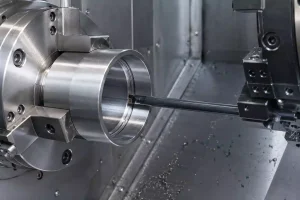
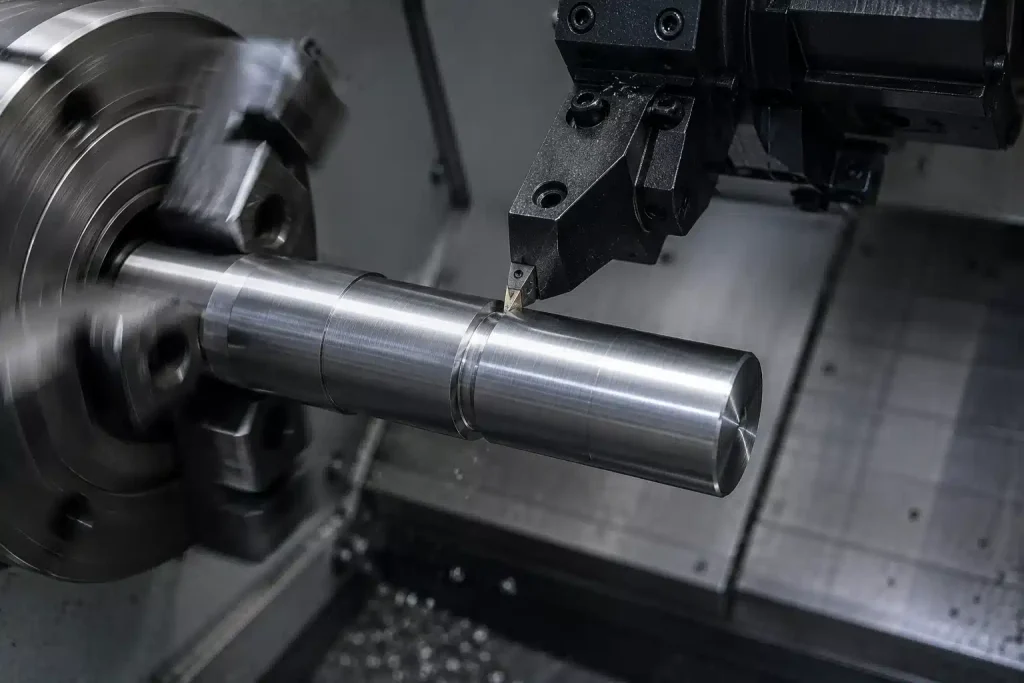
金属シャフトに外溝を形成する切削工具を示すCNC溝加工プロセス

目次

Groove machining is a common but often underestimated process in CNC machining. A small groove feature may serve functions such as sealing, positioning, lubrication, tool relief, or assembly clearance. This article explains the manufacturing logic of groove machining from several aspects, including its definition, machining process, groove machining types, tool selection, and key parameters.

What Is Groove Machining?

Groove machining refers to the process of using specific cutting tools to cut grooves of a certain depth, width, and cross-sectional shape into the surface of a workpiece.

This process is primarily used to achieve specific mechanical functions, such as axial positioning via circlip grooves, preventing high-pressure fluid leakage with seal grooves, or creating oil tracks in journal bearings and guides to optimize lubrication distribution.

Groove Machining Process Workflow

Standard CNC groove machining encompasses the entire lifecycle from engineering design to final on-site precision cutting, to ensure precise control over groove width and depth:

Engineering Design

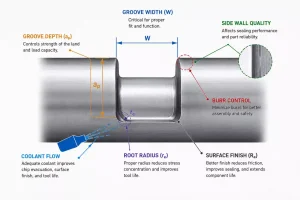
Based on functional requirements like sealing or positioning, the groove’s geometric cross-section is defined in CAD drawings. The design phase must specify groove width tolerances, depth tolerances, root fillets, and side-wall verticality to provide a solid basis for subsequent processing.

Setup and Tool Alignment

Once the program is generated, appropriate chucks or fixtures are selected based on the machining location. High-precision radial and axial tool alignment is performed to ensure the machining coordinates match the blueprint specifications.

Rough Grooving

For wider grooves, multiple straight plunges or segmented cutting methods are employed to efficiently remove material while maintaining smooth chip evacuation and leaving a uniform allowance for finishing.

Bottom Micro-Adjustment

After the tool reaches the groove floor, a lateral sweeping or steering motion is executed to remove the stepped stock left by roughing, ensuring the floor is flat and the width is corrected.

Finish Cleaning

The tool plunges along one side-wall to the floor, traverses horizontally, and retracts upward along the opposite wall. This continuous path completes the finishing of both side-walls and the floor in one motion, preventing tool marks.

Retraction and Inspection

The tool retracts along a safe path and chips are cleared. Specialized gauges are then used to verify groove width, depth, and chamfers against acceptance standards.

Groove Machining Types

Based on the machining location and cutting logic, groove machining is categorized into the following core operational types:

External Grooving

External grooving is the standard process performed on turning centers using radial plunge or lateral turning paths—the focus of this process is ensuring side-wall finish and floor flatness through high-pressure coolant injection, making it the most common method for machining circlip grooves and seal rings on shaft components.

Internal Grooving

Internal grooving process showing a boring bar cutting an O-ring groove inside a metal bore

Internal grooving refers to cutting operations performed within a blind bore—the primary challenge is managing vibration caused by high $L/D$ (length-to-diameter) ratios, which typically requires dedicated anti-vibration boring bars with internal cooling and the use of stepped feeding or lateral base-cleaning paths to overcome chip evacuation difficulties in confined spaces.

Face Grooving

Face grooving is the process of circular cutting performed on the face of a workpiece via tool-path interpolation—because the cutting radius changes with depth, this process relies on Constant Surface Speed (CSS) control and precise entry-angle adjustments to maintain stable cutting forces throughout the circular operation.

Relief Grooving

Relief grooving is a functional operation performed to create clearance at shaft shoulders or thread ends—the purpose is to eliminate machining stress or provide space for mating components, typically utilizing predefined fixed-depth paths to remove excess material rapidly and accurately.

Spiral Grooving

Spiral grooving is a specialized process realized through the synchronized interpolation of rotational motion and axial feed—the technical difficulty lies in maintaining the precise ratio between feed rate and spindle speed (helix angle), commonly used for creating dynamic lubrication tracks inside bushings.

Profile Grooving

Profile grooving is the process of cutting complex shapes using multi-axis contour interpolation—for special geometries like trapezoidal or dovetail slots, this process replaces specialized form tools with CNC 3-axis interpolation, utilizing fine, layered cutting paths to ensure geometric accuracy and minimize scallop height.

Required Tools for Groove Machining

High-quality grooving relies on the synergy of high-rigidity cutting tools, stable workholding, and precision measurement instruments.

  • Turning Grooving Tools: Dedicated to CNC旋盤; they feature specialized chipbreakers to force chip curling and breakage in tight spaces.

  • Milling Grooving Cutters and End Mills: Used on machining centers to cut various slots on non-rotating parts via lateral or axial feed.

  • Rigid Tool Holders: High-strength steel holders that ensure the tool tip does not deflect or chatter under extreme radial cutting forces.

  • Anti-Vibration Boring Bars: Equipped with heavy metal cores or damping modules to suppress harmonics during long-overhang internal machining.

  • High-Pressure Coolant Systems: Directs high-pressure fluid through the tool to force chips out of the groove, preventing recutting.

  • Specialized Groove Gauges: Including calipers, micrometers, and Go/No-Go gauges for high-precision verification of root diameters and widths.

Key Parameters for Precision Groove Machining

Groove machining key parameters showing cutting speed, feed rate, depth of cut, tool overhang, and coolant flow

In groove machining, achieving high-precision results relies on the precise control of several core parameters. These factors affect machining efficiency, tool life, chip evacuation, groove surface quality, and dimensional stability.

  • Cutting Speed Vc: Governs machining efficiency and tool life. Excessive speeds lead to high cutting temperatures and built-up edges that damage side-wall finish, while insufficient speeds reduce efficiency and can induce work hardening.
  • Feed Rate f: Dictates the machining rhythm and chip morphology. Proper feed rates ensure efficient chip breakage and evacuation; otherwise, chips may become entangled, causing side-wall scarring.
  • Depth of Cut ap: Directly impacts cutting forces. Excessive depth increases spindle load and risks clogging the evacuation path, leading to secondary cutting and insert chipping.
  • System Rigidity (Tool Overhang): Determines machining stability. Excessive overhang induces harmonics (chatter), resulting in wavy patterns on the groove floor and loss of geometric tolerance.
  • Coolant Pressure: Crucial for semi-enclosed operations. High-pressure coolant is the primary mechanism for forcing chips out; inadequate pressure leads to debris accumulation and surface damage.
  • Tool Path: Dictates load distribution. Optimized entry/exit strategies and segmented cutting minimize dwell marks and prevent sudden impact loads that could lead to insert failure.

Precautions in Groove Machining

Strict control of the following parameters is essential to ensure process quality and production yield.

Chip Control

Grooving is a classic enclosed cutting process prone to clogging. For internal turning, holders with through-coolant are often preferred to flush chips out, preventing side-wall scarring.

Tool Overhang

For deep grooves or internal bores, the overhang-to-diameter ratio, or L/D, should remain within safe limits, typically L/D ≤ 3 for steel bars. If long overhang is unavoidable, reduce parameters or switch to damped bars.

Step-Over Distance

When machining wide grooves, maintain a step-over of 60% to 80% of the tool width to prevent massive intermediate steps that trigger load spikes. Use arc entry/exit paths to eliminate dwell marks.

Material Properties

Highly ductile materials (e.g., aluminum or copper) tend to form built-up edges. Prioritize polished, sharp inserts and use ample coolant to reduce the friction coefficient.

よくあるご質問

What Is the Difference Between Grooving and Slotting?

These terms carry different focuses in mechanical manufacturing:

  • Grooving: Refers to cutting specific geometric cross-sections on rotating parts, such as OD, ID, or face grooves, with emphasis on side-wall finish and tight tolerances.
  • Slotting: Typically associated with milling. It refers to using end mills or side-and-face cutters to cut linear or enclosed channels, such as keyways or T-slots, on non-rotating parts.

Why Is Chip Control Important in Groove Machining?

Chip management directly determines process consistency:

  • Restricted Evacuation: Deep, narrow grooves block chip escape, often leading to recutting.
  • Surface Damage: Crushed chips can damage surface roughness and lead to part rejection.
  • Tool Failure: Clogging creates sudden load spikes, causing insert chipping or bar breakage, which is a critical risk in automated mass production.

Which Materials Are Suitable for Groove Machining?

When planning grooving operations, it is helpful to understand how different materials affect tool life and process stability:

  • Free-Machining Steels: These materials are generally easier to groove because they produce short, brittle chips that are easier to evacuate, reducing the risk of clogging in narrow grooves.
  • アルミニウム合金: Aluminum alloys are fast to cut but prone to built-up edge, also known as BUE. Polished, sharp inserts and sufficient coolant help keep the groove surface finish clean.
  • Stainless Steels, Especially 300 Series: These materials are prone to work hardening. In practice, the tool should not dwell or stay in one position during cutting, because local hardening can lead to premature tool wear or failure.
  • Titanium and Superalloys: These materials are more difficult to groove because of poor thermal conductivity and heat concentration near the cutting edge. High-pressure through-coolant is often recommended to extend tool life and stabilize the process.

結論

The fundamental challenge of groove machining lies in achieving high-precision control within confined spaces. In CNC mass production, blindly adopting uniform cutting parameters frequently results in tool failure or surface damage. Only by deeply analyzing material properties, designing logical cutting paths, and matching correct chipbreaking solutions can manufacturers ensure high-quality output under stringent sealing and positioning requirements.

この記事を共有する
フェイスブック
ツイッター
LinkedIn
WhatsApp

CNC加工プロジェクトを始める準備はできていますか?

図面をアップロードすると、1営業日以内にDFMフィードバックと見積もりが得られます。